Introduction
If you run an online store, Google Shopping can become one of the most powerful channels for generating sales. However, simply running Shopping campaigns is not enough. Many businesses spend money on clicks but fail to convert visitors into customers. This is why understanding How to improve Google Shopping conversion rates is essential for every ecommerce business.
Google Shopping allows potential customers to see your products directly in search results, including images, prices, reviews, and store information. Because shoppers can view product details before clicking, Shopping campaigns often attract highly qualified traffic. Yet, without proper optimization, even high-quality traffic may not result in sales.
Improving conversion rates means turning more visitors into paying customers. When your conversion rate increases, your advertising budget becomes more efficient, your return on investment grows, and your business becomes more profitable.
In this comprehensive guide, you will learn practical strategies, optimization techniques, and best practices that can significantly improve your Google Shopping campaign performance and help your ecommerce store achieve better results.
Understanding Google Shopping Conversion Rates
Before optimizing campaigns, it is important to understand what conversion rate means.
A conversion rate is the percentage of users who complete a desired action after clicking your ad. In ecommerce, this action is usually a purchase.
Conversion Rate Formula
Conversion Rate = (Conversions ÷ Clicks) × 100
For example:
Conversion Rate = 5%
The higher the conversion rate, the more efficiently your campaigns generate sales.
Why Conversion Rates Matter
Higher conversion rates help businesses:
- Increase sales revenue
- Reduce customer acquisition costs
- Improve advertising ROI
- Maximize marketing budgets
- Scale campaigns profitably
Many advertisers focus only on increasing clicks. However, sales—not clicks—should always be the primary goal.
Factors Affecting Google Shopping Conversion Rates
Several factors influence conversion performance:
- Product feed quality
- Product pricing
- Product images
- Customer reviews
- Landing page experience
- Website speed
- Mobile usability
- Ad targeting
- Bidding strategy
- Product availability
Understanding these elements creates the foundation for long-term success.
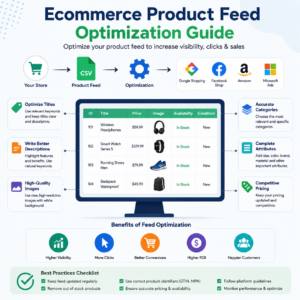
How to Improve Google Shopping Conversion Rates Through Product Feed Optimization
Your product feed is the backbone of every Google Shopping campaign.
Google uses product feed information to determine when and where your products appear. Poor feeds lead to poor performance.
Optimize Product Titles
Product titles are one of the most important ranking factors.
Instead of:
“Running Shoes”
Use:
“Men’s Lightweight Running Shoes Breathable Sports Sneakers Blue”
Effective titles include:
- Brand
- Product type
- Key features
- Size
- Color
- Model number
Best Practices
- Put important keywords first
- Stay descriptive
- Avoid keyword stuffing
- Follow Google’s guidelines
Improve Product Descriptions
Descriptions help Google understand products.
Include:
- Main features
- Benefits
- Specifications
- Usage information
Well-written descriptions increase product relevance and visibility.
Use High-Quality Images
Images strongly influence purchasing decisions.
Your images should be:
- High resolution
- Clear and professional
- Well-lit
- Product-focused
- Free from distractions
Avoid:
- Watermarks
- Promotional text
- Low-quality images
Complete Product Attributes
Fill every relevant field in Merchant Center.
Important attributes include:
- Brand
- GTIN
- MPN
- Product category
- Color
- Size
- Material
- Condition
Complete data improves ad quality and targeting accuracy.
Keep Inventory Updated
Nothing frustrates customers more than clicking on an item that is unavailable.
Update:
- Prices
- Inventory
- Promotions
- Availability
Regular synchronization prevents shopping experience issues.
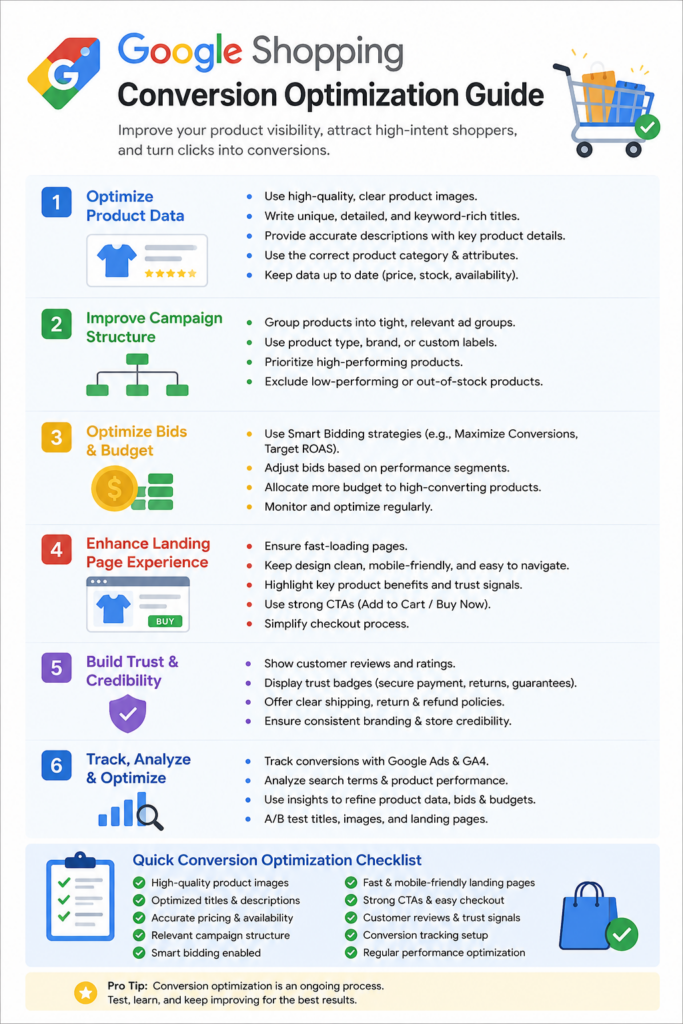
Improve Product Pages for Better Conversions
Many advertisers focus only on ads and forget the landing page.
Even the best Shopping campaign cannot compensate for a poor product page.
Create Strong Product Pages
Every product page should include:
- High-quality images
- Multiple product views
- Product videos
- Detailed descriptions
- Specifications
- Customer reviews
The more information customers receive, the more confident they become.
Improve Website Speed
Page speed directly affects conversions.
Slow websites increase bounce rates and reduce sales.
Ways to improve speed:
- Compress images
- Use CDN services
- Reduce unnecessary scripts
- Optimize hosting
- Enable browser caching
Benefits of Faster Pages
- Better user experience
- Lower bounce rates
- Higher conversions
- Improved SEO rankings
Mobile Optimization
Most ecommerce traffic comes from mobile devices.
Ensure:
- Responsive design
- Easy navigation
- Fast loading
- Mobile-friendly checkout
- Large clickable buttons
A poor mobile experience can dramatically reduce conversion rates.
Simplify Checkout
Complicated checkout processes cause cart abandonment.
Keep checkout simple by:
- Reducing form fields
- Offering guest checkout
- Providing multiple payment methods
- Displaying trust badges
- Showing shipping information upfront
Every extra step creates friction.
Use Smart Campaign Targeting and Bidding Strategies
Targeting the right audience can dramatically improve campaign performance.
Segment Products Properly
Do not place all products into one campaign.
Create groups based on:
- Product category
- Brand
- Profit margin
- Best sellers
- Seasonal products
Segmentation gives better control over optimization.
Prioritize High-Converting Products
Analyze performance data regularly.
Identify:
- Best-selling products
- Highest conversion products
- Most profitable products
Allocate more budget to proven winners.
Use Smart Bidding
Google’s automated bidding strategies use machine learning.
Popular options include:
Target ROAS
Focuses on return on ad spend.
Maximize Conversion Value
Optimizes for revenue generation.
Enhanced CPC
Adjusts bids automatically based on conversion probability.
Testing different bidding strategies helps identify the most profitable approach.
Add Negative Keywords
Negative keywords prevent irrelevant traffic.
Examples:
Benefits include:
- Better traffic quality
- Lower wasted spend
- Higher conversion rates
Analyze Search Terms
Review search term reports regularly.
Look for:
- High-converting keywords
- Irrelevant searches
- New opportunities
Continuous refinement improves campaign efficiency.
Build Trust and Increase Customer Confidence
Trust plays a major role in ecommerce conversions.
People buy from businesses they trust.
Collect Product Reviews
Reviews provide social proof.
Benefits include:
- Increased credibility
- Better click-through rates
- Higher conversions
- Improved customer confidence
Encourage customers to leave reviews after purchases.
Use Seller Ratings
Seller ratings appear directly in ads.
They help shoppers evaluate businesses quickly.
Higher ratings often result in:
- More clicks
- More trust
- More sales
Display Security Features
Customers want assurance that transactions are safe.
Show:
- SSL certificates
- Secure payment badges
- Money-back guarantees
- Privacy policies
Trust signals reduce purchase hesitation.
Offer Transparent Policies
Clearly display:
- Return policies
- Shipping details
- Refund processes
- Delivery timelines
Transparency improves customer satisfaction.
Showcase Customer Testimonials
Testimonials provide real-world validation.
Include:
- Customer photos
- Success stories
- Verified reviews
These elements help visitors feel confident about buying.
Advanced Optimization Techniques for Maximum Results
Once the basics are in place, advanced strategies can further improve results.
Use Audience Targeting
Combine Shopping campaigns with audience data.
Target:
- Previous website visitors
- Past customers
- Cart abandoners
- Similar audiences
Audience layering improves targeting precision.
Implement Remarketing
Remarketing helps recover lost sales.
Many visitors do not purchase on their first visit.
Remarketing allows you to:
- Re-engage visitors
- Promote viewed products
- Recover abandoned carts
- Increase conversion rates
Monitor Competitor Pricing
Pricing significantly impacts purchasing decisions.
Regularly compare:
- Product prices
- Shipping costs
- Promotions
Competitive pricing often leads to more conversions.
Run Promotions
Special offers attract attention.
Examples include:
- Discount codes
- Limited-time deals
- Free shipping
- Bundle offers
Promotions can create urgency and boost purchases.
A/B Test Everything
Testing helps identify what works best.
Test:
- Product titles
- Product images
- Landing pages
- Pricing displays
- Call-to-action buttons
Small improvements often create significant results over time.
Track Conversion Data Accurately
Use:
- Google Ads Conversion Tracking
- Google Analytics
- Enhanced Conversions
Accurate data leads to smarter optimization decisions.
Key Metrics to Monitor
- Conversion rate
- Cost per conversion
- Return on ad spend
- Click-through rate
- Average order value
- Revenue generated
Regular analysis ensures continuous improvement.
Learn Google Shopping Optimization at WebLiquids Institute
Digital marketing skills are becoming increasingly valuable for ecommerce professionals, entrepreneurs, and business owners.
Students who want practical experience with Google Ads, ecommerce marketing, SEO, PPC advertising, and conversion optimization can learn through industry-focused training programs at WebLiquids Institute.
Why Choose WebLiquids Institute?
- Practical learning approach
- Experienced industry trainers
- Live project experience
- Updated digital marketing curriculum
- Hands-on campaign management training
Institute Details
WebLiquids Institute
Address: SCO 114-115, 2nd Floor, Sector 34-A, Chandigarh, 160022
Phone: 829-829-5419
Website: https://www.webliquids.com
Whether you are a beginner or a working professional, WebLiquids Institute provides practical digital marketing knowledge that helps students develop real-world skills.
Frequently Asked Questions (FAQs)
1. What is a good Google Shopping conversion rate?
A good conversion rate varies by industry, but many successful ecommerce stores achieve conversion rates between 2% and 5%, while top-performing stores often exceed these numbers.
2. Why are my Google Shopping ads getting clicks but no sales?
Possible reasons include poor landing pages, high prices, weak product descriptions, slow website speed, poor targeting, or lack of customer trust signals.
3. How important are product images in Google Shopping?
Product images are extremely important because they are often the first thing shoppers notice before clicking an ad.
4. Does website speed affect Google Shopping conversions?
Yes. Faster websites provide a better user experience and generally achieve higher conversion rates.
5. What is product feed optimization?
Product feed optimization involves improving product titles, descriptions, categories, attributes, and images to improve visibility and performance.
6. Should I use Smart Bidding for Shopping campaigns?
Smart Bidding can be highly effective when enough conversion data is available. Testing different strategies helps determine the best option.
7. How often should I update my product feed?
Ideally, product feeds should be updated daily or automatically synchronized with your store inventory.
8. What role do reviews play in conversion rates?
Reviews increase trust, improve credibility, and often lead to higher conversion rates.
9. Can remarketing improve Shopping campaign performance?
Yes. Remarketing helps bring back visitors who previously interacted with your products but did not complete a purchase.
10. How do I track Google Shopping conversions?
You can track conversions using Google Ads Conversion Tracking, Google Analytics, and Enhanced Conversions.
Conclusion
Understanding How to improve Google Shopping conversion rates is essential for any ecommerce business that wants to maximize sales and advertising profitability. Success comes from optimizing product feeds, improving product pages, using smart bidding strategies, building customer trust, and continuously testing campaign performance.
Businesses that focus on data-driven optimization often achieve higher sales, lower acquisition costs, and better returns on advertising spend. By applying the strategies discussed in this guide, you can steadily increase the effectiveness of your Shopping campaigns and create a stronger ecommerce presence.
If you want to master Google Ads, ecommerce marketing, PPC advertising, and conversion optimization professionally, consider learning from WebLiquids Institute. With practical training, experienced mentors, and real-world projects, students can gain the skills needed to succeed in the digital marketing industry.
Remember, the key to long-term success is continuous improvement. Keep testing, keep optimizing, and keep learning. That is the most reliable path to mastering How to improve Google Shopping conversion rates and achieving sustainable ecommerce growth.