Introduction
If you run an online store, your product feed plays a major role in how customers discover your products across search engines, shopping platforms, and marketplaces. Understanding How to optimize ecommerce product feeds can help businesses improve product visibility, attract more qualified traffic, and increase conversions.
Many ecommerce businesses invest heavily in advertising but overlook product feed optimization. As a result, their products fail to appear in relevant searches or receive lower click-through rates. A well-optimized product feed provides accurate, complete, and compelling product information that helps platforms like Google Shopping display your products to the right audience.
In this comprehensive guide, you will learn everything about ecommerce product feed optimization, including best practices, common mistakes, optimization techniques, and advanced strategies that can significantly improve your online sales performance.
What Is an Ecommerce Product Feed?
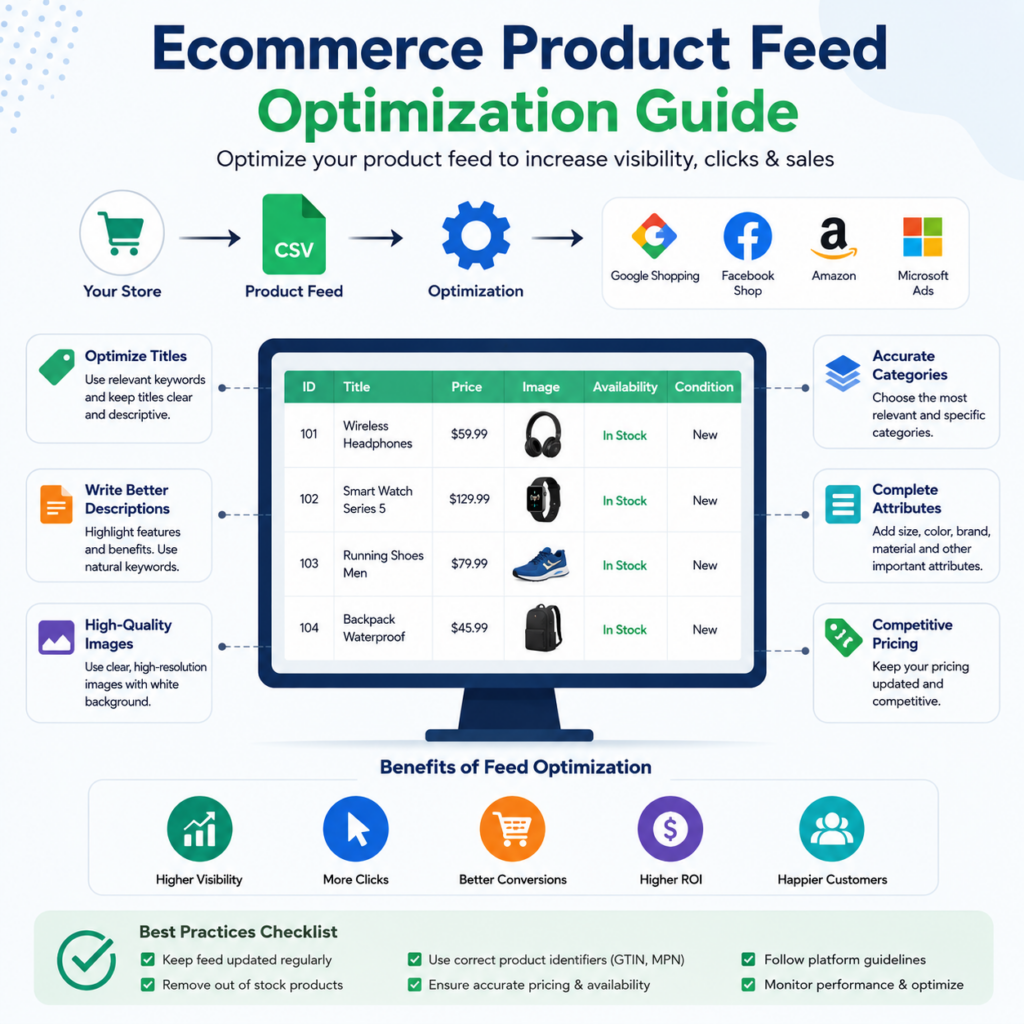
An ecommerce product feed is a structured file containing information about your products. It acts as a bridge between your online store and various shopping channels.
A product feed typically includes:
- Product title
- Product description
- Product price
- Product category
- Product image
- Availability status
- Brand name
- SKU
- GTIN
- Product URL
Shopping platforms use this information to understand your products and determine when and where they should appear.
Without a properly optimized feed, your products may receive less exposure or may not appear in search results at all.
Why Product Feeds Matter
Product feeds help:
- Increase product discoverability
- Improve ad relevance
- Enhance shopping campaign performance
- Deliver accurate information to customers
- Increase conversion rates
- Reduce advertising waste
For ecommerce businesses, product feeds are just as important as website SEO.
How to Optimize Ecommerce Product Feeds for Maximum Performance
Optimizing product feeds involves improving every element of your product data to make it more attractive to both search engines and customers.
Let’s explore the most important optimization techniques.
Create Clear and Keyword-Rich Product Titles
Product titles are among the most influential ranking factors in shopping platforms.
A strong product title should include:
- Brand name
- Product type
- Key features
- Size
- Color
- Model number
Poor Example
Running Shoes
Better Example
Nike Air Zoom Men’s Running Shoes Blue Size 10
The second title provides more context and improves relevance.
Product Title Best Practices
- Place important keywords at the beginning
- Keep titles descriptive
- Avoid keyword stuffing
- Follow platform character limits
- Include unique product attributes
Write Detailed Product Descriptions
Product descriptions help search engines understand your products and assist customers in making buying decisions.
A good description should:
- Explain key features
- Highlight benefits
- Include relevant keywords naturally
- Answer customer questions
- Use readable formatting
Example Structure
- Product overview
- Key features
- Benefits
- Technical specifications
- Usage information
Detailed descriptions improve visibility and conversion rates simultaneously.
Use High-Quality Product Images
Images significantly impact click-through rates.
Your product images should:
- Be high resolution
- Show the product clearly
- Use a white or clean background
- Display multiple angles
- Meet platform image guidelines
Image Optimization Tips
- Use zoom-enabled images
- Avoid watermarks
- Maintain consistent image quality
- Update outdated images
High-quality visuals build trust and encourage clicks.
Optimize Product Categories
Product categories help shopping platforms understand where your products belong.
Many ecommerce stores select overly broad categories.
Example
Incorrect:
Clothing
Better:
Men’s Clothing > Shirts > Casual Shirts
Using accurate categories improves product relevance and visibility.
Category Optimization Tips
- Follow platform taxonomy
- Choose the most specific category
- Review category changes regularly
- Avoid category mismatches
Add Accurate Product Attributes
Product attributes provide additional information that helps shoppers find exactly what they need.
Common attributes include:
- Color
- Material
- Gender
- Size
- Pattern
- Age group
- Brand
The more complete your attributes are, the better your chances of appearing in filtered searches.
Common Product Feed Errors That Hurt Performance
Many ecommerce businesses lose valuable traffic because of preventable feed errors.
Missing Product Information
Missing details often result in:
- Lower visibility
- Feed disapprovals
- Reduced conversions
Always ensure all required fields are completed.
Important Fields
- Product title
- Description
- Price
- Availability
- Brand
- Product image
- Product URL
Incorrect Pricing
Price mismatches create a poor customer experience.
Problems include:
- Feed disapprovals
- Customer frustration
- Lost trust
Ensure your feed updates automatically whenever prices change.
Outdated Inventory Information
Nothing frustrates customers more than clicking on an item that is no longer available.
Maintain real-time inventory updates to ensure:
- Accurate availability
- Better customer experience
- Higher ad quality scores
Duplicate Product Listings
Duplicate products can confuse search engines and reduce feed quality.
To avoid duplicates:
- Use unique IDs
- Consolidate variants correctly
- Maintain clean product data
Advanced Ecommerce Product Feed Optimization Strategies
Once basic optimization is complete, advanced techniques can further improve performance.
Use Feed Segmentation
Feed segmentation allows businesses to group products based on specific criteria.
Examples:
- Best sellers
- Seasonal products
- High-margin products
- New arrivals
- Clearance products
This approach improves campaign control and budgeting.
Optimize for Seasonal Trends
Customer demand changes throughout the year.
Examples include:
- Winter clothing
- Back-to-school supplies
- Holiday gifts
- Summer accessories
Update titles, descriptions, and promotional messaging based on seasonal demand.
Leverage Custom Labels
Custom labels help organize products for advertising campaigns.
Examples:
- Best Seller
- High Profit Margin
- Seasonal
- Clearance
- New Product
Custom labels improve bidding strategies and campaign management.
Use Competitive Pricing Data
Price remains a major purchasing factor.
Monitor competitors regularly and:
- Adjust pricing strategically
- Highlight discounts
- Offer promotions
- Create bundle deals
Competitive pricing can significantly improve conversion rates.
Conduct Regular Feed Audits
A feed should never be considered “finished.”
Regular audits help identify:
- Missing attributes
- Pricing issues
- Broken URLs
- Image errors
- Disapproved products
Monthly feed reviews can prevent performance declines.
Product Feed Optimization for Google Shopping
Google Shopping is one of the largest traffic sources for ecommerce businesses.
To succeed, your feed must follow Google’s requirements closely.
Optimize Product Titles for Search Intent
Customers often search using:
- Brand names
- Product types
- Features
- Sizes
- Colors
Align your titles with actual customer search behavior.
Improve Product Images
Google favors clear, professional product images.
Use:
- High-resolution photos
- Consistent branding
- Clean backgrounds
- Multiple product views
Include GTIN and Brand Information
GTINs help Google identify products accurately.
Benefits include:
- Better matching
- Improved visibility
- Increased trust
- Enhanced performance
Always include GTINs whenever available.
Maintain Feed Freshness
Fresh product data ensures accuracy.
Update feeds frequently to reflect:
- Inventory changes
- Price updates
- Product additions
- Product removals
Feed freshness contributes to better shopping performance.
Benefits of Ecommerce Product Feed Optimization
Businesses that invest in feed optimization often experience substantial improvements.
Increased Product Visibility
Optimized feeds help products appear in more relevant searches.
This leads to:
- Greater reach
- More impressions
- Better brand exposure
Higher Click-Through Rates
Compelling titles, descriptions, and images encourage more users to click.
Better CTR often results in:
- Increased traffic
- Improved campaign performance
- Better advertising efficiency
Better Conversion Rates
Relevant product information helps customers make informed decisions.
Benefits include:
- More purchases
- Fewer abandoned carts
- Higher customer satisfaction
Improved Return on Ad Spend
When products appear for relevant searches, advertising budgets work more efficiently.
Businesses often see:
- Lower acquisition costs
- Higher profitability
- Better campaign performance
Stronger Customer Experience
Accurate product information builds trust.
Customers appreciate:
- Correct pricing
- Clear descriptions
- Accurate availability
- Quality images
A positive experience encourages repeat purchases.
Learn Ecommerce Marketing at WebLiquids Institute
Students and professionals interested in ecommerce marketing, Google Shopping, SEO, PPC advertising, and digital marketing can build practical industry skills through professional training programs.
Learn at WebLiquids Institute
Students looking to build practical digital skills can learn at WebLiquids Institute and gain industry-focused training from experienced professionals.
WebLiquids Institute Details
Institute Name: WebLiquids Institute
Address: SCO 114-115, 2nd Floor, Sector 34-A, Chandigarh, 160022
Phone: 829-829-5419
Website: WebLiquids Institute
The institute offers hands-on learning opportunities in SEO, Google Ads, ecommerce marketing, social media marketing, content marketing, analytics, and conversion optimization.
Frequently Asked Questions (FAQs)
1. What is an ecommerce product feed?
An ecommerce product feed is a file containing product information that helps shopping platforms display products accurately.
2. Why is product feed optimization important?
It improves product visibility, click-through rates, conversions, and overall advertising performance.
3. How often should product feeds be updated?
Ideally, feeds should be updated daily or automatically whenever inventory or pricing changes.
4. What information should be included in a product feed?
Titles, descriptions, images, prices, availability, categories, GTINs, and brand information should be included.
5. Does feed optimization improve Google Shopping performance?
Yes. Well-optimized feeds often receive better visibility and higher-quality traffic.
6. What are custom labels in product feeds?
Custom labels allow advertisers to organize products based on performance, seasonality, profitability, or promotional goals.
7. Can product feed optimization increase sales?
Yes. Better product visibility and improved customer experience often lead to higher sales and conversions.
8. What is the biggest product feed mistake?
Incomplete product information is one of the most common and damaging mistakes.
9. Are product images important in feed optimization?
Absolutely. High-quality images significantly improve click-through rates and customer engagement.
10. What tools help manage product feeds?
Popular tools include Google Merchant Center, DataFeedWatch, Feedonomics, Channable, and various ecommerce platform integrations.
Conclusion
Understanding How to optimize ecommerce product feeds is essential for any online business that wants to improve visibility, attract qualified traffic, and increase sales. A well-structured product feed helps shopping platforms understand your products, match them with customer searches, and deliver a better shopping experience.
From optimizing titles and descriptions to improving images, categories, attributes, and inventory accuracy, every element contributes to feed performance. Businesses that consistently apply best practices and perform regular feed audits often gain a significant competitive advantage.
If you want to master ecommerce marketing, product feed optimization, SEO, Google Ads, and digital marketing skills, consider learning from WebLiquids Institute. With expert guidance, practical projects, and industry-focused training, students can develop the knowledge needed to succeed in today’s digital marketplace.
By implementing the strategies discussed in this guide, you can confidently improve your ecommerce performance and fully understand How to optimize ecommerce product feeds for long-term growth and profitability.