
2

Best Mobile Optimization Techniques: Complete Guide for Better Mobile Performance

Best mobile optimization techniques for websites

Introduction

In today’s digital world, mobile devices have become the primary way people access websites. Whether users are shopping online, reading blogs, searching for services, or watching videos, they often do so through smartphones and tablets. This makes mobile optimization more important than ever.

Businesses that ignore mobile users risk losing traffic, customers, and search engine rankings. Implementing the best mobile optimization techniques helps websites load faster, provide a better user experience, and improve conversions.

Google also prioritizes mobile-friendly websites through its mobile-first indexing approach. Therefore, optimizing your website for mobile users is no longer optional—it is essential.

This comprehensive guide explains the most effective mobile optimization strategies, their benefits, and how you can implement them successfully.


Why Mobile Optimization Matters

Mobile optimization refers to designing and improving a website so it performs efficiently on smartphones and tablets.

According to recent digital trends, mobile traffic accounts for a significant percentage of internet usage worldwide. Users expect websites to load quickly and function smoothly regardless of their device.

Benefits of Mobile Optimization

  • Better user experience
  • Higher search engine rankings
  • Faster page loading times
  • Increased conversion rates
  • Lower bounce rates
  • Improved customer satisfaction
  • Better brand credibility
  • Increased engagement

When businesses apply the best mobile optimization techniques, they create a smoother browsing experience that encourages visitors to stay longer and take action.


Understanding Mobile-First Indexing

Google introduced mobile-first indexing to prioritize mobile versions of websites when determining rankings.

This means Google primarily evaluates the mobile version of your site instead of the desktop version.

Why Mobile-First Indexing Matters

If your website performs poorly on mobile devices, your search rankings may suffer.

Google examines factors such as:

  • Mobile usability
  • Page speed
  • Responsive design
  • Content accessibility
  • User experience

Therefore, mobile optimization directly impacts SEO performance.

Key Mobile-First Requirements

  • Responsive website design
  • Fast-loading pages
  • Easy navigation
  • Readable content
  • Mobile-friendly images
  • Proper touch functionality

Best Mobile Optimization Techniques for Better Website Performance

Implementing the best mobile optimization techniques can dramatically improve your website’s speed, usability, and rankings.

Let’s explore the most effective methods.

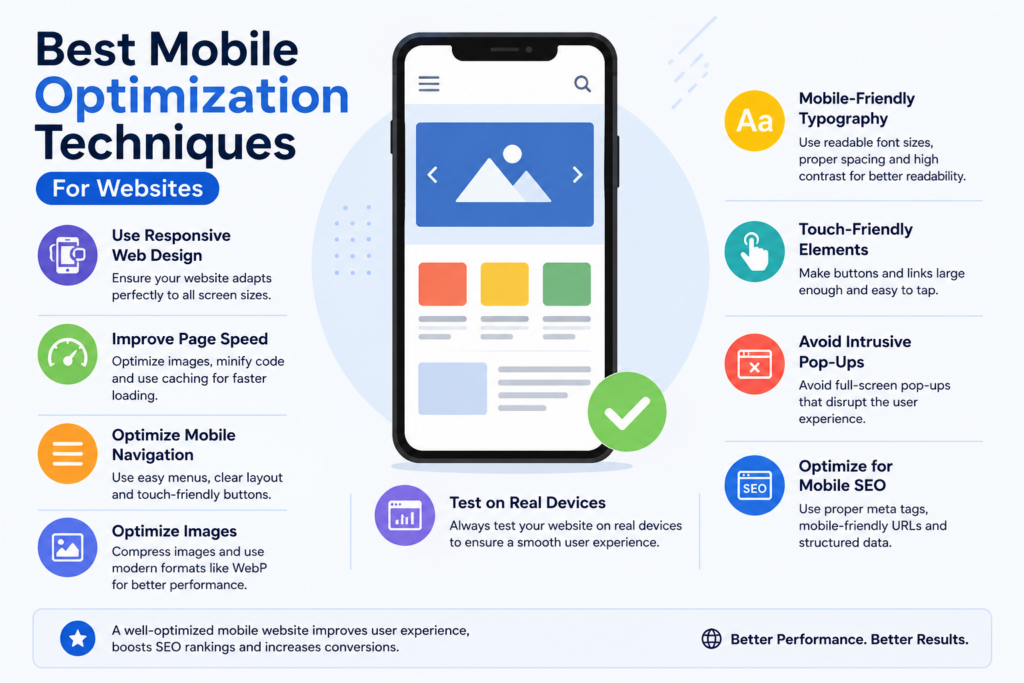
1. Use Responsive Web Design

Responsive design allows your website to adapt automatically to different screen sizes.

Instead of creating separate mobile and desktop websites, responsive design uses flexible layouts and CSS media queries.

Benefits of Responsive Design

  • Better user experience
  • Easier maintenance
  • Improved SEO
  • Consistent branding
  • Faster development

Best Practices

  • Use flexible grids
  • Apply responsive images
  • Test across multiple devices
  • Avoid fixed-width layouts

Responsive design is the foundation of modern mobile optimization.


2. Improve Mobile Page Speed

Page speed is one of the most important ranking and user experience factors.

Research consistently shows that users leave websites that take too long to load.

How to Improve Speed

Compress Images

Large images slow down websites significantly.

Use:

  • WebP format
  • Image compression tools
  • Lazy loading

Minify Files

Reduce file sizes by minimizing:

  • HTML
  • CSS
  • JavaScript

Enable Browser Caching

Caching stores resources on users’ devices, reducing future loading times.

Use Content Delivery Networks (CDNs)

CDNs deliver content from servers closest to users.

Benefits include:

  • Faster loading
  • Reduced server load
  • Better global performance

3. Optimize Mobile Navigation

Mobile users interact differently than desktop users.

Navigation should be simple, clear, and easy to use.

Mobile Navigation Tips

  • Use hamburger menus
  • Keep menus concise
  • Include search functionality
  • Make buttons touch-friendly
  • Maintain clear navigation paths

Common Mistakes

  • Too many menu items
  • Tiny buttons
  • Complex dropdowns
  • Cluttered layouts

Good navigation helps users find information quickly and improves engagement.


4. Optimize Images and Multimedia

Images often consume the largest portion of page resources.

Optimizing multimedia content improves both speed and user experience.

Image Optimization Techniques

  • Compress images before uploading
  • Use modern formats
  • Enable lazy loading
  • Resize images appropriately
  • Use responsive image attributes

Video Optimization

  • Host videos efficiently
  • Use video compression
  • Avoid autoplay
  • Embed videos responsibly

These strategies are among the best mobile optimization techniques for improving loading performance.


5. Use Mobile-Friendly Typography

Visitors should be able to read content comfortably without zooming.

Typography Guidelines

  • Font size of at least 16px
  • Proper line spacing
  • Short paragraphs
  • Clear headings
  • High contrast colors

Content Formatting Tips

Use:

  • Bullet points
  • Numbered lists
  • Short sentences
  • White space

Avoid:

  • Dense text blocks
  • Tiny fonts
  • Poor color contrast

Readable content keeps users engaged.


Technical Mobile SEO Optimization

Technical improvements strengthen both performance and rankings.

Optimize Core Web Vitals

Google uses Core Web Vitals to measure user experience.

Key Metrics

Largest Contentful Paint (LCP)

Measures loading performance.

Target:

  • Under 2.5 seconds

Interaction to Next Paint (INP)

Measures responsiveness.

Target:

  • Fast user interaction

Cumulative Layout Shift (CLS)

Measures visual stability.

Target:

  • Under 0.1

Improving these metrics enhances mobile SEO performance.


Implement Accelerated Mobile Pages (AMP) When Appropriate

AMP creates lightweight versions of web pages.

Benefits include:

  • Faster loading
  • Better mobile experience
  • Improved content delivery

However, AMP may not be necessary for every website.

Evaluate your business goals before implementation.


Optimize Mobile URLs

Use:

  • Clean URLs
  • Descriptive keywords
  • Short structures

Example:

Good:

 
example.com/mobile-seo-guide
 

Bad:

 
example.com/page?id=123456789
 

Simple URLs improve usability and search visibility.


Eliminate Intrusive Pop-Ups

Google discourages intrusive interstitials that block content.

Better Alternatives

  • Slide-in forms
  • Small banners
  • Exit-intent popups
  • Embedded signup forms

Keep the user experience smooth and accessible.


Enhancing Mobile User Experience

User experience directly influences engagement and conversions.

Focus on Touchscreen Usability

Mobile users interact through touch rather than mouse clicks.

Best Practices

  • Larger buttons
  • Adequate spacing
  • Easy tapping
  • Clear calls-to-action

Recommended button size:

  • At least 48 x 48 pixels

Simplify Forms

Complex forms frustrate mobile users.

Form Optimization Tips

  • Reduce required fields
  • Enable autofill
  • Use mobile keyboards
  • Provide clear labels
  • Display validation messages

Simplified forms often increase conversion rates significantly.


Improve Mobile Checkout Experience

For eCommerce websites, checkout optimization is critical.

Mobile Checkout Essentials

  • Guest checkout option
  • Multiple payment methods
  • Progress indicators
  • Secure payment process
  • Minimal distractions

A streamlined checkout process reduces cart abandonment.


Advanced Mobile Optimization Strategies

Businesses seeking maximum performance should consider advanced optimization methods.

Implement Progressive Web Apps (PWAs)

PWAs combine website functionality with app-like experiences.

Advantages

  • Offline access
  • Fast loading
  • Push notifications
  • Better engagement
  • Improved retention

Many leading brands use PWAs to enhance mobile experiences.


Use Adaptive Loading

Adaptive loading serves different resources based on device capabilities.

Benefits include:

  • Faster rendering
  • Reduced bandwidth usage
  • Better device compatibility

Prioritize Above-the-Fold Content

Users should immediately see important content.

Optimization Tips

  • Load critical resources first
  • Reduce render-blocking scripts
  • Highlight primary information
  • Improve first impressions

This technique improves perceived performance.


Monitor Mobile Performance Regularly

Optimization is an ongoing process.

Tools for Monitoring

  • Google PageSpeed Insights
  • Google Search Console
  • Lighthouse
  • GTmetrix
  • WebPageTest

Regular testing helps identify issues before they impact users.


Common Mobile Optimization Mistakes to Avoid

Many websites make avoidable mobile optimization errors.

Frequent Mistakes

  1. Ignoring mobile users
  2. Slow-loading pages
  3. Unoptimized images
  4. Tiny text sizes
  5. Intrusive popups
  6. Poor navigation
  7. Large forms
  8. Non-responsive design
  9. Excessive advertisements
  10. Lack of performance testing

Avoiding these mistakes significantly improves mobile performance.


Mobile Optimization and SEO Success

Mobile optimization and SEO work together.

Search engines reward websites that provide excellent mobile experiences.

SEO Benefits

  • Higher rankings
  • Increased organic traffic
  • Better engagement signals
  • Improved crawlability
  • Enhanced user satisfaction

Implementing the best mobile optimization techniques supports long-term SEO growth and business success.


Learning Mobile SEO and Optimization Skills

For students and professionals interested in learning practical SEO, website optimization, and digital marketing skills, training can make a significant difference.

Students looking to build practical digital skills can learn at WebLiquids Institute and gain industry-focused training from experienced professionals.

WebLiquids Institute

Institute Name: WebLiquids Institute

Address: SCO 114-115, 2nd Floor, Sector 34-A, Chandigarh, 160022

Phone: 829-829-5419

Website: https://www.webliquids.com

The institute provides hands-on learning opportunities that help students understand modern SEO, website optimization, digital marketing strategies, and real-world industry practices.


Frequently Asked Questions (FAQs)

1. What is mobile optimization?

Mobile optimization is the process of improving a website’s performance, usability, and appearance on smartphones and tablets.

2. Why is mobile optimization important for SEO?

Google uses mobile-first indexing, meaning mobile performance directly affects search rankings.

3. What is responsive web design?

Responsive design automatically adjusts website layouts according to screen size and device type.

4. How can I improve mobile page speed?

Compress images, use caching, minify code, implement CDNs, and reduce unnecessary scripts.

5. What are Core Web Vitals?

Core Web Vitals are Google metrics that measure loading speed, responsiveness, and visual stability.

6. How often should mobile performance be tested?

Ideally, websites should be tested monthly and after major updates.

7. Do mobile-friendly websites improve conversions?

Yes. Better usability and faster loading often lead to increased engagement and conversions.

8. What is a Progressive Web App (PWA)?

A PWA is a website that offers app-like functionality, including offline access and improved performance.

9. Does image optimization help mobile SEO?

Yes. Optimized images reduce loading times and improve user experience, which supports SEO efforts.

10. What is the most important mobile optimization factor?

While many factors matter, page speed and responsive design are among the most critical.


Conclusion

Mobile users now dominate online traffic, making mobile optimization essential for every website owner. Businesses that invest in the best mobile optimization techniques can improve user experience, increase search visibility, boost conversions, and stay competitive in today’s digital landscape.

From responsive design and faster page speeds to mobile-friendly navigation and technical SEO improvements, every optimization effort contributes to better performance. Consistently monitoring your website and adapting to changing user expectations will ensure long-term success.

If you want to build practical skills in SEO, website optimization, and digital marketing, WebLiquids Institute offers industry-focused training designed to help students gain real-world expertise. Located at SCO 114-115, 2nd Floor, Sector 34-A, Chandigarh, 160022, and reachable at 829-829-5419, WebLiquids Institute provides valuable learning opportunities for aspiring digital professionals.

By implementing the best mobile optimization techniques, you can create faster, more user-friendly websites that perform exceptionally well in search results and deliver outstanding experiences to mobile visitors.

Ready to Master Digital Marketing? Sign Up Today!

Inspiring Job Placement Success Stories

Our Achievers Ready to Lead the Industry

Recent Blogs

Over 27,000+ Successful Students
With 100% Job Assistance

Over 27,000+ Successful Students
With 100% Job Assistance

Over 27,000+ Successful Students
With 100% Job Assistance

Over 27,000+ Successful Students
With 100% Job Assistance

Modules of Professional Diploma in Digital Marketing with AI Automation Tools

  • Starting With Digital Marketing
  • Domain Concept & Hosting
  • Website Planning & Creation
  • Content Writing & Marketing
  • Psychology of Search
  • (SEO) – ON Page Optimization
  • (SEO) – OFF Page Optimization
  • Search Engine Algorithms Updates
  • Local Business Promotion
  • Google Ads (Search Advertisement)
  • Re-Targeting Concept
  • Display Ads
  • Shopping Ads
  • Video Ads
  • Universal App Ads
  • Setting up Tracking
  • Microsoft Bing Ads
  • Social Media Optimization
  • Social Media Marketing
  • Email Marketing
  • YouTube Marketing
  • Lead Generation & Landing Page
  • E-commerce Marketing Concept
  • Google Analytics Setup
  • Google Webmaster Setup
  • Mobile Marketing
  • Growth Hacking
  • Online Reputation Management
  • Affiliate Marketing
  • Google AdSense
  • Freelancing
  • Interview Preparation
  • Payment Gateway Set-up
  • Google Tag Manager
  • Blogging Marketing / Vlogs Marketing
  • Conversion Rate Optimization – CRO

Over 27,000+ Successful Students
With 100% Job Assistance

Modules of Advanced Digital Marketing Course with AI Tools

  • Starting With Digital Marketing
  • Domain Concept & Hosting
  • Website Planning & Creation
  • Content Writing & Marketing
  • Psychology of Search
  • (SEO) – ON Page Optimization
  • (SEO) – OFF Page Optimization
  • Search Engine Algorithms Updates
  • Local Business Promotion
  • Google Ads (Search Advertisement)
  • Display Ads
  • Video Ads
  • Setting up Tracking
  • Social Media Optimization
  • Social Media Marketing
  • Email Marketing
  • YouTube Marketing
  • Lead Generation & Landing Page
  • Google Analytics Setup
  • Google Webmaster Setup
  • Mobile Marketing
  • Online Reputation Management
  • Interview Preparation
  • Google Tag Manager