2

How to Compress Images Without Losing Quality: Complete Beginner's Guide

How to Compress Images Without Losing Quality – Image Optimization Techniques for Faster Websites and Better SEO

Introduction

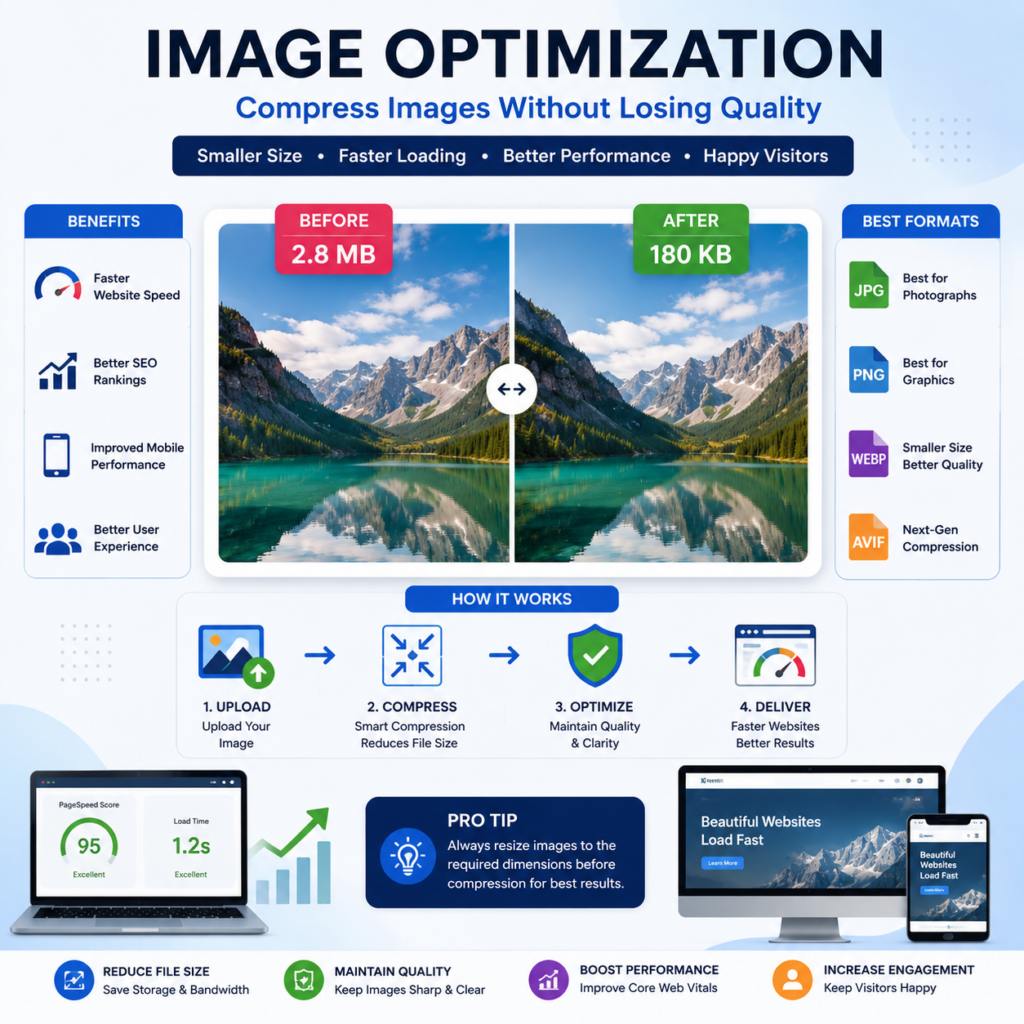
If you own a website, run an online store, manage a blog, or work in digital marketing, image optimization is something you cannot ignore. Large image files can slow down your website, affect user experience, and even impact search engine rankings. This is why understanding how to compress images without losing quality is an essential skill for website owners, content creators, designers, and marketers.

Many beginners assume that compressing images automatically makes them look blurry or pixelated. Fortunately, modern image optimization techniques allow you to significantly reduce file size while maintaining excellent visual quality. When done correctly, image compression improves website speed, enhances user experience, reduces storage requirements, and supports better SEO performance.

In this comprehensive guide, you will learn everything about how to compress images without losing quality, including compression methods, best image formats, recommended tools, common mistakes, and professional best practices.


Why Image Compression Matters for Websites

Images often account for the largest portion of a webpage’s total size. High-resolution photos can easily reach several megabytes, causing websites to load slowly.

Benefits of Image Compression

  • Faster website loading speed
  • Improved user experience
  • Better mobile performance
  • Reduced bandwidth usage
  • Higher search engine rankings
  • Improved Core Web Vitals
  • Lower hosting costs
  • Better conversion rates

Impact on SEO

Google considers page speed an important ranking factor. When images are not optimized, websites become slower and visitors are more likely to leave before the page loads completely.

Studies consistently show that users expect websites to load quickly. A delay of even a few seconds can increase bounce rates and reduce engagement.

Therefore, learning how to compress images without losing quality can directly contribute to better SEO performance and improved website results.


Understanding Image Compression Basics

Before compressing images, it is important to understand how image compression works.

What Is Image Compression?

Image compression is the process of reducing the file size of an image while preserving its visual appearance as much as possible.

The main goal is to remove unnecessary data so that the image occupies less storage space and loads faster online.

Two Main Types of Compression

1. Lossless Compression

Lossless compression reduces file size without removing important image information.

Benefits include:

  • No visible quality loss
  • Perfect image reproduction
  • Suitable for logos and graphics
  • Ideal for professional projects

Examples:

  • PNG compression
  • Certain WebP compression methods
  • TIFF optimization

2. Lossy Compression

Lossy compression removes some image data to achieve a smaller file size.

Benefits include:

  • Much smaller file sizes
  • Faster loading times
  • Excellent for website images

Examples:

  • JPEG compression
  • WebP compression
  • AVIF compression

The key is finding the right balance between image quality and file size.


Best Image Formats for Quality and Performance

Choosing the correct image format is one of the most important parts of image optimization.

JPEG (JPG)

JPEG remains one of the most widely used image formats.

Advantages

  • Small file size
  • Excellent for photographs
  • Universal compatibility
  • Fast loading

Best For

  • Product photos
  • Blog images
  • Photography websites
  • Social media graphics

PNG

PNG offers lossless compression and transparency support.

Advantages

  • High image quality
  • Transparent backgrounds
  • Sharp graphics

Best For

  • Logos
  • Icons
  • Infographics
  • Website graphics

WebP

WebP is a modern image format developed for the web.

Advantages

  • Smaller file sizes than JPEG
  • Better quality retention
  • Transparency support
  • Faster performance

Best For

  • Websites
  • E-commerce stores
  • Blogs
  • Digital marketing projects

AVIF

AVIF is one of the newest image formats available today.

Advantages

  • Exceptional compression
  • High-quality visuals
  • Better performance than JPEG

Best For

  • Modern websites
  • High-performance web applications

Selecting the appropriate format is a major step in mastering how to compress images without losing quality effectively.


Step-by-Step Process to Compress Images Without Losing Quality

Let’s go through a practical workflow that professionals use.

Step 1: Start with High-Quality Original Images

Always begin with the highest-quality version available.

Poor-quality originals cannot be improved through compression.

Step 2: Resize Before Compressing

Many website images are uploaded at unnecessarily large dimensions.

For example:

  • Original image: 5000 × 3000 pixels
  • Website display size: 1200 × 720 pixels

Resize the image first before compressing.

Step 3: Choose the Correct Format

Use:

  • JPEG for photos
  • PNG for graphics
  • WebP for modern websites
  • AVIF for advanced optimization

Step 4: Adjust Compression Settings

Most tools allow quality settings between 1–100.

Recommended range:

  • 70–85% for JPEG
  • High-quality WebP settings
  • Lossless PNG optimization

Step 5: Compare Before and After

Always zoom in and inspect:

  • Text clarity
  • Edge sharpness
  • Color accuracy
  • Image details

Step 6: Test Website Performance

After uploading compressed images:

  • Check page speed
  • Test mobile performance
  • Verify visual quality

This workflow helps ensure how to compress images without losing quality becomes a repeatable and reliable process.


Best Tools for Image Compression

Modern tools make image optimization quick and easy.

Online Compression Tools

Popular options include:

  • TinyPNG
  • CompressJPEG
  • ImageOptim Online
  • Squoosh
  • iLoveIMG

Benefits:

  • No installation required
  • Beginner-friendly
  • Fast processing

Desktop Software

Professional users often prefer desktop applications.

Examples include:

  • Adobe Photoshop
  • Affinity Photo
  • GIMP
  • ImageOptim

Benefits:

  • Greater control
  • Batch processing
  • Advanced optimization

WordPress Plugins

WordPress users can automate image compression.

Popular plugins:

  • Smush
  • ShortPixel
  • Imagify
  • EWWW Image Optimizer

Benefits:

  • Automatic optimization
  • Bulk image compression
  • SEO-friendly workflows

Common Mistakes to Avoid During Image Compression

Many website owners unknowingly make errors that hurt image quality.

Uploading Massive Images

Large images consume bandwidth and slow websites.

Always resize before uploading.

Over-Compressing Images

Excessive compression causes:

  • Blurry photos
  • Pixelation
  • Poor user experience

Ignoring Modern Formats

Many websites still rely entirely on JPEG and PNG.

WebP and AVIF often provide much better performance.

Using Screenshots Instead of Graphics

Screenshots often contain unnecessary data and poor scalability.

Use properly designed graphics whenever possible.

Forgetting Mobile Users

Mobile visitors often represent the majority of website traffic.

Always optimize images for mobile performance.


Advanced Image Optimization Techniques

Once you understand the basics, you can apply advanced strategies.

Lazy Loading

Lazy loading delays image loading until users scroll near them.

Benefits include:

  • Faster page speed
  • Better user experience
  • Reduced bandwidth usage

Responsive Images

Different devices require different image sizes.

Responsive images automatically serve the appropriate version.

Content Delivery Networks (CDNs)

CDNs distribute images globally.

Benefits:

  • Faster loading
  • Reduced server load
  • Improved international performance

Image Caching

Caching stores images temporarily for repeat visitors.

Benefits:

  • Faster return visits
  • Reduced server requests

Automated Optimization Pipelines

Modern websites often automate image processing during uploads.

Benefits include:

  • Consistent quality
  • Faster workflows
  • Reduced manual work

Image Compression and Digital Marketing Success

Image optimization affects more than just page speed.

Better User Experience

Visitors stay longer when websites load quickly.

Improved Conversion Rates

Faster pages often generate:

  • More leads
  • More sales
  • Better engagement

Enhanced Mobile Performance

Mobile users expect instant loading experiences.

Stronger Search Rankings

Google rewards fast, user-friendly websites.

For digital marketers, understanding image optimization is now a valuable skill.

Students interested in developing practical SEO, website optimization, and digital marketing expertise can learn at WebLiquids Institute and gain industry-focused training from experienced professionals. These real-world skills help professionals improve website performance, search visibility, and user engagement.


How Digital Marketing Students Can Learn Image Optimization

Image optimization is a key component of modern SEO and web performance strategies.

Professionals working in:

  • SEO
  • Content marketing
  • Web development
  • E-commerce
  • Blogging
  • Graphic design

all benefit from understanding image compression techniques.

Training programs that include SEO and website optimization help students build practical industry skills.

At WebLiquids Institute, learners gain hands-on exposure to digital marketing concepts, including website optimization, SEO fundamentals, content strategy, and performance improvement techniques used by modern businesses.

Whether you are a student, freelancer, entrepreneur, or working professional, developing expertise in website performance can create valuable career opportunities.


Frequently Asked Questions (FAQs)

1. What is image compression?

Image compression is the process of reducing image file size while maintaining acceptable visual quality.

2. Why is image compression important for SEO?

Compressed images improve page speed, user experience, and website performance, which can positively influence search rankings.

3. What is the difference between lossy and lossless compression?

Lossless compression preserves all image data, while lossy compression removes some data to achieve smaller file sizes.

4. Which image format is best for websites?

WebP is often considered one of the best formats because it offers excellent quality and smaller file sizes.

5. Can image compression reduce quality?

Yes, excessive compression can reduce quality. Proper optimization balances file size and visual appearance.

6. What is the ideal image size for websites?

The ideal size depends on usage, but most website images should be resized to the actual display dimensions before upload.

7. Which tools are best for image compression?

Popular tools include TinyPNG, Squoosh, ImageOptim, Photoshop, Smush, and ShortPixel.

8. How often should website images be optimized?

Every image uploaded to a website should be optimized before publishing.

9. Is WebP better than JPEG?

In many cases, WebP provides smaller file sizes while maintaining similar or better visual quality.

10. Does image compression improve website loading speed?

Yes. Smaller image files reduce download times and improve overall page performance.


Conclusion

Understanding how to compress images without losing quality is one of the most valuable skills for website owners, bloggers, marketers, designers, and business owners. Proper image optimization helps improve page speed, user experience, SEO performance, and conversion rates while keeping visuals sharp and professional.

By choosing the right image format, resizing images appropriately, using modern compression tools, and following best practices, you can significantly reduce file sizes without sacrificing quality. As websites continue to prioritize speed and performance, mastering how to compress images without losing quality becomes increasingly important for long-term online success.

For individuals who want to build practical digital marketing and website optimization skills, WebLiquids Institute offers industry-focused training designed to prepare students for real-world projects and career growth.

WebLiquids Institute
Address: SCO 114-115, 2nd Floor, Sector 34-A, Chandigarh, 160022
Phone: 829-829-5419
Website: WebLiquids Institute

Learning modern SEO, website optimization, and performance improvement techniques can help professionals stay competitive in today’s digital landscape, and WebLiquids Institute provides the practical training needed to develop those skills.

Ready to Master Digital Marketing? Sign Up Today!

Inspiring Job Placement Success Stories

Our Achievers Ready to Lead the Industry

Recent Blogs

Over 27,000+ Successful Students
With 100% Job Assistance

Over 27,000+ Successful Students
With 100% Job Assistance

Over 27,000+ Successful Students
With 100% Job Assistance

Over 27,000+ Successful Students
With 100% Job Assistance

Modules of Professional Diploma in Digital Marketing with AI Automation Tools

  • Starting With Digital Marketing
  • Domain Concept & Hosting
  • Website Planning & Creation
  • Content Writing & Marketing
  • Psychology of Search
  • (SEO) – ON Page Optimization
  • (SEO) – OFF Page Optimization
  • Search Engine Algorithms Updates
  • Local Business Promotion
  • Google Ads (Search Advertisement)
  • Re-Targeting Concept
  • Display Ads
  • Shopping Ads
  • Video Ads
  • Universal App Ads
  • Setting up Tracking
  • Microsoft Bing Ads
  • Social Media Optimization
  • Social Media Marketing
  • Email Marketing
  • YouTube Marketing
  • Lead Generation & Landing Page
  • E-commerce Marketing Concept
  • Google Analytics Setup
  • Google Webmaster Setup
  • Mobile Marketing
  • Growth Hacking
  • Online Reputation Management
  • Affiliate Marketing
  • Google AdSense
  • Freelancing
  • Interview Preparation
  • Payment Gateway Set-up
  • Google Tag Manager
  • Blogging Marketing / Vlogs Marketing
  • Conversion Rate Optimization – CRO

Over 27,000+ Successful Students
With 100% Job Assistance

Modules of Advanced Digital Marketing Course with AI Tools

  • Starting With Digital Marketing
  • Domain Concept & Hosting
  • Website Planning & Creation
  • Content Writing & Marketing
  • Psychology of Search
  • (SEO) – ON Page Optimization
  • (SEO) – OFF Page Optimization
  • Search Engine Algorithms Updates
  • Local Business Promotion
  • Google Ads (Search Advertisement)
  • Display Ads
  • Video Ads
  • Setting up Tracking
  • Social Media Optimization
  • Social Media Marketing
  • Email Marketing
  • YouTube Marketing
  • Lead Generation & Landing Page
  • Google Analytics Setup
  • Google Webmaster Setup
  • Mobile Marketing
  • Online Reputation Management
  • Interview Preparation
  • Google Tag Manager