How to Increase Ecommerce Sales with Email Marketing
How to Increase Ecommerce Sales with Email Marketing Introduction In today’s competitive online marketplace, attracting visitors to your website is only half the battle. The
In today’s competitive online marketplace, attracting visitors to your website is only half the battle. The real challenge is converting those visitors into paying customers and encouraging them to make repeat purchases. This is where email marketing becomes one of the most powerful tools for ecommerce businesses.
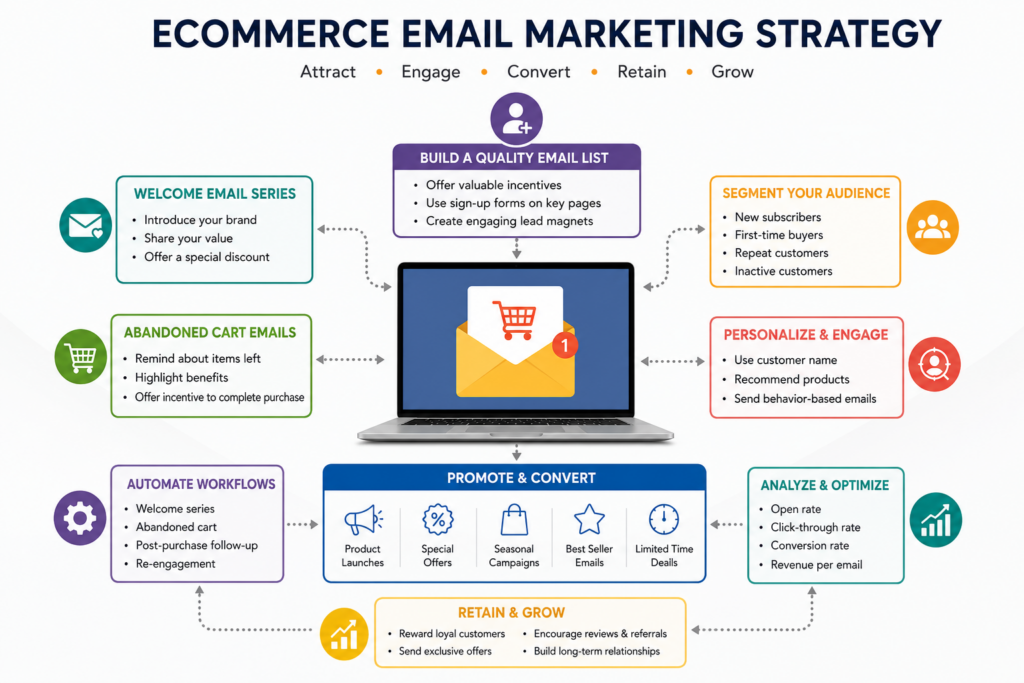
If you are wondering how to increase ecommerce sales with email marketing, you are not alone. Many successful online stores generate a significant portion of their revenue through well-planned email campaigns. Email marketing helps businesses communicate directly with customers, build trust, promote products, recover lost sales, and increase customer loyalty.
Unlike social media platforms where algorithms control visibility, email gives you direct access to your audience. When used correctly, it can deliver exceptional returns and consistent sales growth.
In this detailed guide, we will explore proven strategies, best practices, and actionable techniques that can help you understand how to increase ecommerce sales with email marketing and maximize revenue from your online store.
Email marketing remains one of the highest ROI digital marketing channels available today. It allows ecommerce businesses to connect with customers at every stage of the buying journey.
When customers subscribe to your emails, they are giving you permission to communicate with them directly. This creates a valuable opportunity to influence purchasing decisions.
Before creating campaigns, you must understand your customers.
Track:
This information helps create personalized campaigns that are more likely to convert.
Instead of sending the same email to everyone, divide subscribers into groups such as:
Segmentation improves relevance and significantly increases sales.
A high-quality email list is the foundation of successful ecommerce email marketing.
Encourage visitors to subscribe by offering:
Place signup forms on:
Avoid purchasing email lists. Instead, build a list of genuinely interested subscribers who are more likely to engage and buy.
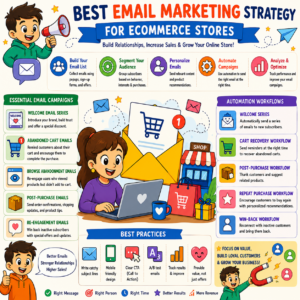
Not all email campaigns serve the same purpose. Successful ecommerce stores use multiple campaign types.
Welcome emails create a strong first impression.
A welcome sequence may include:
Welcome emails often receive higher open rates because subscribers are actively interested in your brand.
Cart abandonment is one of the biggest challenges in ecommerce.
Many shoppers add products to their carts but leave without completing the purchase.
Email 1: Reminder after 1 hour
Email 2: Benefits of the product after 24 hours
Email 3: Limited-time discount after 48 hours
These emails can recover a large percentage of lost sales.
Use customer behavior to recommend relevant products.
Examples:
Personalized recommendations increase conversions significantly.
Promotional campaigns help boost short-term revenue.
Examples include:
Always create urgency through limited-time offers.
Personalization goes beyond adding a customer’s first name.
Customers expect brands to understand their preferences.
For example, if a customer recently purchased running shoes, sending recommendations for athletic apparel can increase the chances of another purchase.
Personalized emails generally perform better than generic campaigns.
Even the best strategy can fail if the email itself is poorly designed.
Your subject line determines whether an email gets opened.
Keep subject lines short and compelling.
Each email should have one primary objective.
Examples:
Avoid overwhelming subscribers with multiple actions.
Examples:
CTA buttons should be visible and easy to click.
Most ecommerce emails are opened on mobile devices.
Ensure:
A poor mobile experience can reduce sales opportunities.
Automation allows you to send the right message at the right time without manual effort.
Introduces subscribers to your brand.
Recovers abandoned purchases.
Encourages repeat purchases.
Reconnects with inactive subscribers.
Builds trust and social proof.
Automation saves time while generating ongoing revenue.
Acquiring a new customer is often more expensive than retaining an existing one.
Email marketing helps increase customer retention through consistent communication.
Repeat customers often spend more and buy more frequently.
Tracking results helps improve future campaigns.
Measures how many recipients opened the email.
Measures clicks on links and buttons.
Shows how many subscribers completed desired actions.
Tracks earnings generated from campaigns.
Indicates subscriber dissatisfaction.
Reviewing these metrics helps optimize campaign performance over time.
Many businesses make avoidable mistakes that reduce effectiveness.
Avoiding these mistakes can improve engagement and revenue.
Once the basics are working, consider advanced techniques.
Test:
Small improvements can lead to significant revenue growth.
Display different content based on customer behavior.
For example:
Reward repeat customers with:
Loyal customers contribute significantly to long-term profitability.
Businesses increasingly seek professionals who can manage email marketing campaigns effectively.
Students and working professionals who want practical skills can learn advanced ecommerce and digital marketing strategies at WebLiquids Institute.
WebLiquids Institute provides industry-focused training designed to help learners understand modern marketing tools, automation platforms, customer segmentation, conversion optimization, and ecommerce growth techniques.
WebLiquids Institute
Address: SCO 114-115, 2nd Floor, Sector 34-A, Chandigarh, 160022
Phone: 829-829-5419
Website: https://www.webliquids.com
The institute focuses on practical implementation so students can gain real-world experience and build job-ready skills.
Email marketing helps businesses engage customers, promote products, increase repeat purchases, and generate higher revenue.
Most businesses perform well with one to four emails per week, depending on audience engagement and campaign goals.
An abandoned cart email reminds customers about products left in their shopping cart and encourages them to complete the purchase.
Yes. Email marketing continues to be one of the most effective digital marketing channels with strong ROI and customer engagement.
Email segmentation is the process of dividing subscribers into groups based on behavior, demographics, or purchase history for more targeted communication.
Automated campaigns are emails triggered by specific customer actions such as subscribing, purchasing, or abandoning a cart.
Personalized emails provide relevant recommendations and offers, increasing engagement, conversions, and customer satisfaction.
Important metrics include open rate, click-through rate, conversion rate, revenue per email, and unsubscribe rate.
Absolutely. Email marketing is cost-effective and can help small businesses compete with larger brands.
You can learn practical ecommerce email marketing, automation, and digital marketing skills from experienced trainers at WebLiquids Institute in Chandigarh.
Understanding how to increase ecommerce sales with email marketing is essential for any online business looking to grow sustainably. Email marketing allows you to communicate directly with customers, build trust, recover abandoned carts, promote products, and increase customer loyalty.
By focusing on list building, segmentation, personalization, automation, and performance tracking, businesses can significantly improve conversions and revenue. Whether you are a small online store or a large ecommerce brand, implementing the strategies discussed in this guide will help you master how to increase ecommerce sales with email marketing and create a scalable sales engine for long-term success.
For individuals who want to develop professional digital marketing skills and gain practical industry knowledge, WebLiquids Institute offers comprehensive training programs designed to prepare students for real-world marketing challenges and career opportunities.

How to Increase Ecommerce Sales with Email Marketing Introduction In today’s competitive online marketplace, attracting visitors to your website is only half the battle. The

B2B Email Marketing: The Complete Guide to Generating Leads and Growing Your Business Introduction In today’s digital world, B2B email marketing remains one of the

How to Avoid Spam in Cold Email Campaigns: Complete Beginner’s Guide Introduction If you are using cold emails to generate leads, build business relationships, or

How to Generate B2B Leads Using Cold Email: Complete Beginner’s Guide Introduction If you are looking for a cost-effective way to reach potential clients, learning

How to Promote YouTube Shorts: Complete Guide to Increase Views and Subscribers Introduction If you are creating YouTube Shorts but not getting the views you

How to Use Instagram Influencer Marketing: The Complete Beginner’s Guide Introduction In today’s digital world, social media has become one of the most powerful marketing

Best Instagram Influencer Marketing Strategies: Complete Guide for Business Growth Introduction In today’s digital world, Instagram has become one of the most powerful platforms for

Instagram Ads Targeting Guide: Reach the Right Audience and Maximize Results Introduction Running Instagram ads is easy, but reaching the right audience is where the

Best Instagram Advertising Strategies: A Complete Guide to Higher Engagement, Leads, and Sales Introduction Instagram has become one of the most powerful marketing platforms in

How to Run Instagram Ads: Complete Beginner-to-Advanced Guide How to Run Instagram Ads: Complete Beginner-to-Advanced Guide How to Run Instagram Ads: Complete Beginner-to-Advanced Guide Introduction

How to Generate Leads on Facebook: The Complete Beginner-to-Advanced Guide Introduction In today’s digital world, Facebook remains one of the most powerful platforms for businesses