How to Create SEO-Friendly URLs: Complete Guide for Better Rankings
Introduction
Search engine optimization involves many factors, including content quality, website speed, backlinks, and technical optimization. One element that is often overlooked is the URL structure of a webpage. Although URLs may appear simple, they play an important role in helping both users and search engines understand what a page is about.
A well-structured URL improves readability, enhances user trust, and contributes to better search visibility. When visitors see a clean and descriptive URL, they can quickly identify the content of the page before clicking on it. Search engines also use URLs as one of many signals to understand page relevance.
Businesses, bloggers, marketers, and website owners should understand the importance of creating optimized URLs because every webpage contributes to overall website performance. Whether you manage an e-commerce store, a corporate website, or a personal blog, learning how to create seo friendly url structures can improve your site’s usability and SEO effectiveness.
This comprehensive guide explains URL optimization, its importance, different URL types, best practices, tools, career opportunities, industry applications, and future trends.
What is SEO-Friendly URL?
Definition and Overview
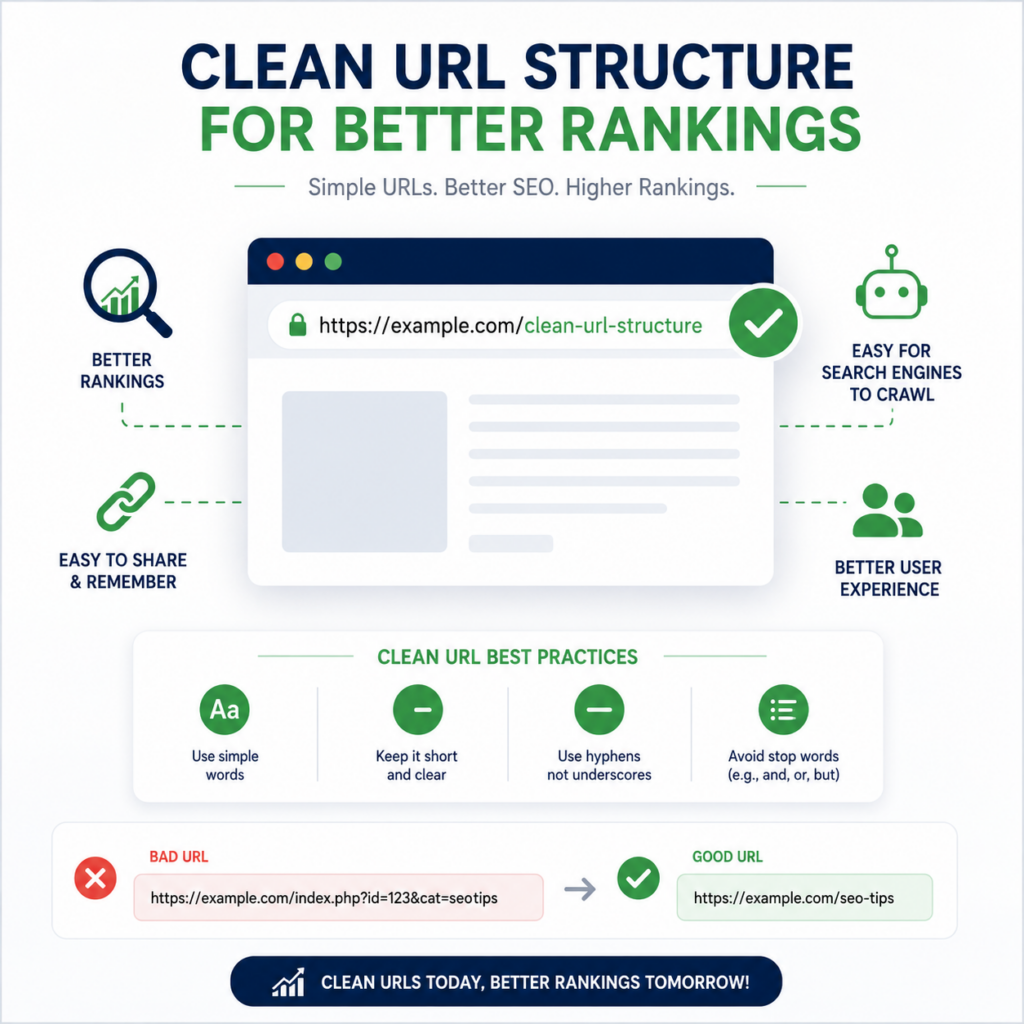
An SEO-friendly URL is a web address designed to be easily understood by both users and search engines. It clearly describes the content of a page using relevant words rather than random numbers, symbols, or unnecessary parameters.
For example:
Good URL:
www.example.com/seo-friendly-url-guide
Poor URL:
www.example.com/page?id=4587&cat=12
The first URL provides clear information about the content, while the second offers little context.
SEO-friendly URLs improve website organization and make content easier to discover, share, and index.
Key Features
An optimized URL generally includes:
- Clear and descriptive words
- Relevant keywords
- Short and simple structure
- Hyphens instead of underscores
- Lowercase letters
- Logical folder hierarchy
- No unnecessary symbols or parameters
- Easy readability
These features enhance user experience while supporting search engine crawling.
How It Works
When search engines crawl a website, they analyze multiple elements including:
- Page title
- Meta description
- Headings
- Content
- Internal links
- URL structure
A descriptive URL helps search engines understand the page topic more efficiently.
Example:
www.example.com/digital-marketing-course
Search engines can quickly determine that the page relates to digital marketing courses.
Another example:
www.example.com/product/123456
This URL provides very little contextual information.
As a result, optimized URLs contribute to improved indexing and user engagement.
Why is it Important?
SEO-friendly URLs provide several advantages for businesses, marketers, and website owners.
Benefits
- Improves search engine understanding
- Enhances user experience
- Increases click-through rates
- Supports content organization
- Simplifies website navigation
- Makes links easier to share
Business Advantages
Companies benefit from optimized URLs because they:
- Build trust with visitors
- Improve brand credibility
- Increase organic traffic potential
- Enhance website structure
- Support digital marketing campaigns
Marketing Relevance
In digital marketing, every click matters.
A clean URL:
- Looks professional
- Encourages users to click
- Improves campaign performance
- Supports content marketing efforts
Career Opportunities
Knowledge of URL optimization is valuable for:
- SEO specialists
- Digital marketers
- Content strategists
- Web developers
- Website managers
Real-World Applications
SEO-friendly URLs are commonly used in:
- Blogs
- E-commerce websites
- News portals
- Educational platforms
- Business websites
- Online directories
Types of URL Structures
Static URLs
Static URLs remain unchanged and are generally preferred for SEO.
Example:
www.example.com/seo-course
Benefits:
- Easy to understand
- Better indexing
- Improved user experience
Dynamic URLs
Dynamic URLs are generated automatically using parameters.
Example:
www.example.com/product?id=567
Although functional, they are often less user-friendly.
Keyword-Rich URLs
These URLs include relevant keywords describing page content.
Example:
www.example.com/email-marketing-guide
Benefits:
- Better readability
- Improved relevance signals
Category-Based URLs
Organize content within logical sections.
Example:
www.example.com/blog/technical-seo-guide
Benefits:
- Better website structure
- Easier navigation
Location-Based URLs
Useful for local SEO campaigns.
Example:
www.example.com/chandigarh-digital-marketing-course
These help target location-specific searches.
Step-by-Step Process
Creating optimized URLs requires planning and consistency.
Step 1: Understand Page Content
Before creating a URL, identify the main topic of the page.
Example:
Page Topic: Digital Marketing Training
Possible URL:
www.example.com/digital-marketing-training
Step 2: Use Relevant Keywords
Include the primary topic naturally.
This helps search engines understand page relevance.
Example:
www.example.com/seo-course-for-beginners
Avoid keyword stuffing.
Step 3: Keep URLs Short
Short URLs are easier to read and share.
Good Example:
www.example.com/seo-tips
Poor Example:
www.example.com/ultimate-complete-guide-to-learning-all-seo-techniques-for-beginners
Step 4: Use Hyphens
Hyphens improve readability.
Correct:
seo-friendly-url
Incorrect:
seo_friendly_url
Step 5: Avoid Special Characters
Avoid:
- %
- &
Â
- ?
- Â
These can create confusion for users and search engines.
Step 6: Use Lowercase Letters
Always use lowercase URLs.
Good:
example.com/content-marketing
Bad:
example.com/Content-Marketing
Step 7: Maintain Consistency
Create URL guidelines for your website.
Consistency helps:
- Search engines
- Website management
- User navigation
Step 8: Remove Unnecessary Words
Avoid filler words whenever possible.
Instead of:
how-to-learn-about-search-engine-optimization
Use:
learn-seo
Step 9: Create Logical Hierarchies
Structure URLs properly.
Example:
www.example.com/courses/seo-training
This creates a clear website architecture.
Step 10: Monitor Performance
Review URLs regularly using SEO tools.
Track:
- Indexing
- Traffic
- Click-through rates
- Crawl issues
Common Mistakes to Avoid
- Using long URLs
- Keyword stuffing
- Random numbers
- Multiple categories
- Uppercase letters
- Unnecessary symbols
- Frequent URL changes
By following these practices, website owners can effectively learn how to create seo friendly url structures that support long-term SEO success.
Tools Used for URL Optimization
Free Tools
Google Search Console
Helps monitor indexing and URL performance.
Google Analytics
Tracks traffic and user behavior.
Google Trends
Identifies keyword opportunities.
SEO Minion
Useful browser extension for SEO analysis.
Paid Tools
Semrush
Provides:
- URL audits
- Site analysis
- Keyword research
Ahrefs
Useful for:
- Site audits
- Backlink analysis
- SEO tracking
Moz
Offers URL optimization insights and SEO recommendations.
Beginner-Friendly Tools
- Yoast SEO
- Rank Math
- Screaming Frog SEO Spider
- Ubersuggest
These tools help beginners analyze and improve website URLs efficiently.
Industry Sectors Using URL Optimization
E-commerce
Online stores use descriptive URLs for:
- Products
- Categories
- Brands
Example:
/mens-running-shoes
Healthcare
Hospitals and clinics create optimized URLs for services.
Example:
/cardiology-services
Education
Educational institutions use structured URLs for courses.
Example:
/digital-marketing-course
Real Estate
Property websites organize listings using location-based URLs.
Example:
/apartments-in-chandigarh
Travel & Tourism
Travel agencies optimize URLs for destinations.
Example:
/manali-tour-packages
IT & Software
Software companies organize documentation and service pages.
Example:
/cloud-computing-solutions
Finance & Banking
Banks create clean URLs for financial services.
Example:
/home-loan
Startups
Startups use optimized URLs to improve discoverability and branding.
Local Businesses
Local companies benefit from location-specific URLs.
Example:
/seo-services-chandigarh
Digital Marketing Agencies
Agencies rely heavily on optimized URLs for service pages, blogs, and landing pages.
Career Opportunities
As SEO continues to grow, professionals with URL optimization knowledge remain in demand.
Job Roles
Popular positions include:
- SEO Executive
- SEO Specialist
- Technical SEO Analyst
- Digital Marketing Executive
- Content Strategist
- Website Administrator
- SEO Consultant
- Search Marketing Manager
Required Skills
Professionals should learn:
- Keyword research
- Technical SEO
- On-page optimization
- Analytics
- Content marketing
- Website architecture
- URL structuring
- Search engine guidelines
Salary Expectations
Salary varies based on experience and location.
Approximate ranges:
- Beginner: ₹2.5–5 LPA
- Mid-Level: ₹5–10 LPA
- Senior Professional: ₹10–20+ LPA
Freelancers and consultants may earn significantly more through project-based work.
Growth Opportunities
Professionals can progress into:
- SEO Manager
- Digital Marketing Manager
- Growth Strategist
- Marketing Director
- Business Consultant
Freelancing Opportunities
Many businesses seek freelancers for:
- SEO audits
- Website optimization
- URL restructuring
- Technical SEO consulting
This creates strong opportunities for independent professionals.
Future Scope
The importance of URL optimization continues to grow as search engines evolve.
Industry Demand
Businesses increasingly recognize the value of technical SEO.
As competition increases, optimized website structures become more important.
AI Impact
Artificial intelligence is changing search behavior.
However, clear URL structures remain useful because:
- Search engines still crawl websites
- Users still evaluate links
- Website organization remains essential
Future Trends
Emerging trends include:
- Semantic SEO
- AI-driven optimization
- Voice search adaptation
- Entity-based search
- Improved website architecture
Automation Influence
Modern SEO tools automate:
- URL recommendations
- Site audits
- Technical analysis
Yet human expertise remains necessary for strategic planning.
Long-Term Career Potential
SEO professionals who understand technical optimization will continue to be valuable.
Learning how to create seo friendly url structures is likely to remain an important skill for years to come.
Learn URL Optimization at WebLiquids Institute
For students and professionals interested in learning SEO and website optimization, WebLiquids Institute provides practical training focused on industry requirements.
Located at:
WebLiquids Institute
SCO 114-115, 2nd Floor, Sector 34-A, Chandigarh, 160022
Phone: 829-829-5419
Website: WebLiquids Institute
The institute focuses on:
- Practical training sessions
- Live project implementation
- Hands-on learning experiences
- Industry-oriented curriculum
- Guidance from experienced professionals
- Placement assistance support
- Real-world SEO strategies
- Technical SEO concepts
Students gain exposure to modern digital marketing practices, helping them develop skills that are relevant to current industry demands.
Whether someone is a beginner exploring digital marketing or a professional seeking advanced SEO knowledge, structured learning can significantly improve career growth and practical understanding.
Conclusion
URL optimization is a fundamental component of effective SEO and website management. A well-structured URL helps search engines understand content, improves user experience, increases click-through rates, and contributes to stronger website organization.
Businesses across industries use optimized URLs to improve visibility and support digital marketing goals. From e-commerce stores and educational institutions to healthcare providers and digital agencies, clean URL structures play a significant role in online success.
For professionals, understanding how to create seo friendly url structures offers valuable career opportunities in SEO, digital marketing, content strategy, and website management. As search technology continues to evolve, URL optimization will remain an important part of building search-friendly and user-focused websites.
FAQs
Q1. What is an SEO-friendly URL?
An SEO-friendly URL is a webpage address that clearly describes page content using readable words instead of random numbers or symbols. It helps both users and search engines understand the page topic more easily.
Q2. Why are optimized URLs important for SEO?
Optimized URLs improve readability, help search engines interpret content, and increase user trust. They also support better website organization and can contribute to improved click-through rates.
Q3. How long should a URL be?
A URL should be as short as possible while still describing the page accurately. Short, clear URLs are easier to read, remember, and share.
Q4. Should keywords be included in URLs?
Yes, relevant keywords can be included naturally when they accurately represent the page content. However, excessive keyword usage should be avoided.
Q5. Are hyphens better than underscores in URLs?
Yes. Search engines generally recommend hyphens because they separate words more clearly and improve readability for both users and crawlers.
Q6. Can changing URLs affect SEO?
Yes. Changing URLs without proper redirects can cause traffic and ranking losses. Always use 301 redirects when modifying existing URLs.
Q7. Is URL optimization difficult for beginners?
No. Once basic SEO principles are understood, creating clean and descriptive URLs becomes a straightforward process that can be applied consistently across a website.
Q8. What tools help analyze URL performance?
Popular tools include Google Search Console, Google Analytics, Semrush, Ahrefs, Moz, Screaming Frog, and Rank Math. These tools help identify optimization opportunities.
Q9. What career opportunities exist in SEO?
SEO offers roles such as SEO Executive, Technical SEO Specialist, SEO Consultant, Content Strategist, Digital Marketing Manager, and Search Marketing Analyst, with strong growth potential.
Q10. Does URL optimization have future relevance?
Yes. Despite advancements in AI and automation, URL structure remains an important element of website organization, user experience, and technical SEO, making it valuable for long-term digital success.
Ready to Master Digital Marketing? Sign Up Today!
Inspiring Job Placement Success Stories
Our Achievers Ready to Lead the Industry


Recent Blogs

Best Mobile Optimization Techniques: Complete Guide for Better Mobile Performance
Best Mobile Optimization Techniques: Complete Guide for Better Mobile Performance Introduction In today’s digital world, mobile devices have become the primary way people access websites.

How to Improve Website Speed: The Complete Beginner-to-Advanced Guide
How to Improve Website Speed: The Complete Beginner-to-Advanced Guide Introduction In today’s digital world, website speed plays a major role in online success. Whether you

Best Brand Building Strategies: A Complete Guide to Growing a Strong and Memorable Brand
Best Brand Building Strategies: A Complete Guide to Growing a Strong and Memorable Brand Introduction Building a successful business today requires much more than offering

How to Increase Brand Awareness: The Complete Guide for Long-Term Business Growth
How to Increase Brand Awareness: The Complete Guide for Long-Term Business Growth Introduction Every successful business has one thing in common: people know and remember

How to Build Brand Online: The Complete Beginner’s Guide
How to Build Brand Online: The Complete Beginner’s Guide Introduction In today’s digital world, every business, freelancer, entrepreneur, and professional needs a strong online presence.

How to Increase Website Traffic From Social Media: A Complete Beginner’s Guide
How to Increase Website Traffic From Social Media: A Complete Beginner’s Guide Introduction In today’s digital world, social media has become one of the most

Best Social Promotion Strategies: A Complete Guide to Growing Your Brand Online
Best Social Promotion Strategies: A Complete Guide to Growing Your Brand Online Introduction In today’s digital world, social media is one of the most powerful

How to Promote Website on Social Media: A Complete Beginner-to-Advanced Guide
How to Promote Website on Social Media: A Complete Beginner-to-Advanced Guide Introduction If you own a website, getting visitors is one of the biggest challenges

How to Build Backlinks for SEO: The Complete Beginner’s Guide
How to Build Backlinks for SEO: The Complete Beginner’s Guide Introduction If you are wondering how to build backlinks for seo, you are already focusing

How to Compress Images Without Losing Quality: Complete Beginner’s Guide
How to Compress Images Without Losing Quality: Complete Beginner’s Guide Introduction If you own a website, run an online store, manage a blog, or work