2

What Is Meta Description in SEO? Complete Guide for Beginners

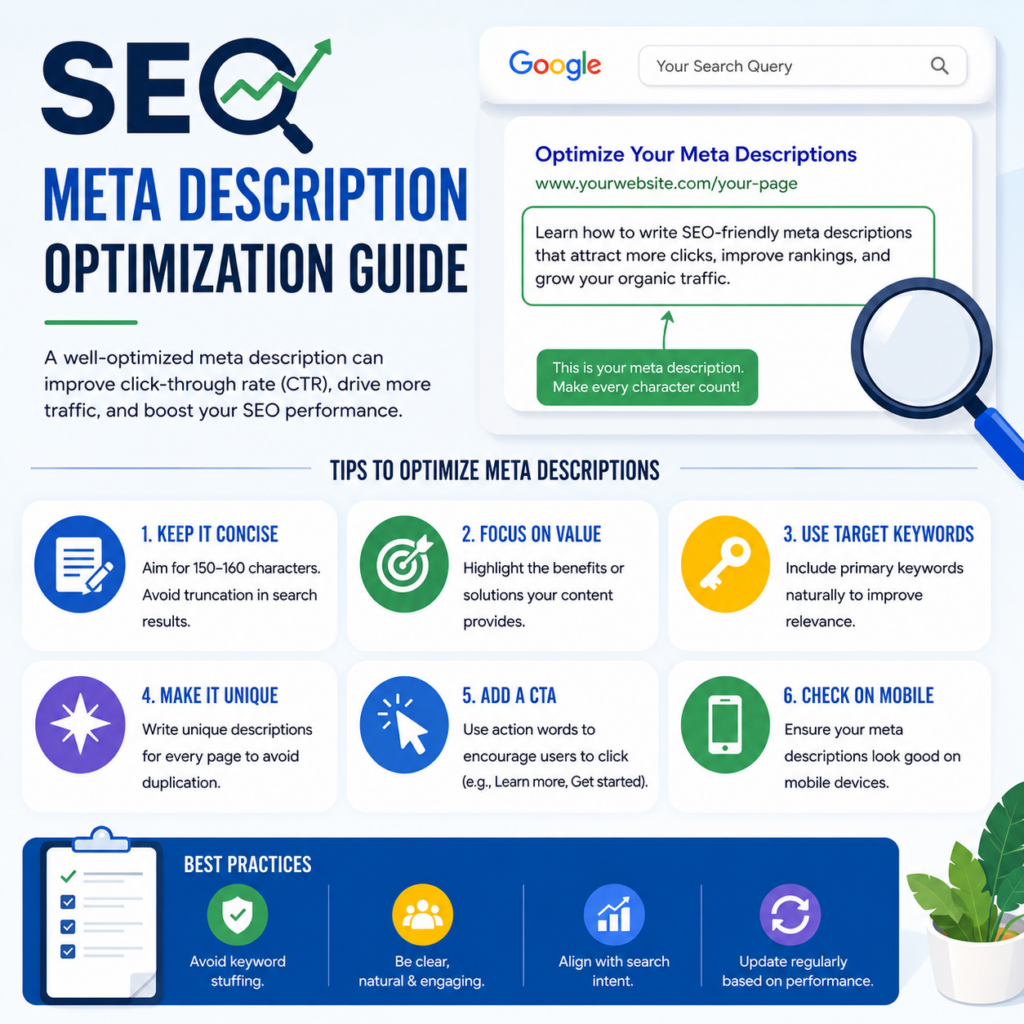
SEO meta description optimization guide

Introduction

When people search for information online, search engines display a list of results that include a title, URL, and a short summary. This summary is known as a meta description. Although it may seem like a small element, it plays an important role in attracting visitors to a website.

A well-written meta description can encourage users to click on a webpage instead of competing search results. It acts as a preview of the content and helps users understand what they can expect before visiting the page.

In today’s competitive digital landscape, businesses, bloggers, marketers, and website owners constantly look for ways to improve visibility and increase website traffic. Search engine optimization (SEO) involves many factors, and meta descriptions remain one of the most valuable elements for improving user engagement.

Understanding What is meta description in SEO helps website owners create better search listings, improve click-through rates, and provide a better experience for users. Whether you manage a business website, e-commerce store, educational portal, or personal blog, learning how to optimize meta descriptions can contribute significantly to your overall SEO strategy.


What is Meta Description in SEO?

Definition and Overview

What is meta description in SEO? A meta description is an HTML attribute that provides a brief summary of a webpage’s content. Search engines often display this text beneath the page title in search results.

The primary purpose of a meta description is to inform users about the content of a webpage and encourage them to click the link.

Typically, a meta description ranges between 150 and 160 characters, although search engines may display different lengths depending on the device and search query.

For example:

Title: Digital Marketing Course for Beginners

Meta Description: Learn digital marketing through practical training, live projects, and expert guidance. Start building in-demand marketing skills today.

This short summary gives users a clear idea of what they will find on the page.

Key Features

Meta descriptions offer several important features:

  • Provide a concise summary of webpage content
  • Help improve click-through rates
  • Enhance user experience
  • Support search visibility
  • Encourage engagement
  • Highlight unique value propositions
  • Influence user decision-making

While meta descriptions are not a direct ranking factor, they can impact user behavior, which indirectly supports SEO performance.

How It Works

When search engines crawl a webpage, they identify the meta description tag within the page code.

Example:

 
<meta name="description" content="Learn SEO techniques, keyword research, and website optimization strategies.">
 

Search engines may display this description in search results if it matches the user’s search intent.

For instance:

A user searches for “SEO training course.”

A webpage with a relevant meta description explaining SEO training benefits is more likely to attract clicks than a page with a vague or missing description.

In some cases, search engines generate their own snippets if they believe another section of the content better matches the search query.


Why is it Important?

Meta descriptions provide value to both users and businesses.

Benefits

  • Improve click-through rates (CTR)
  • Increase user engagement
  • Communicate page relevance
  • Enhance search result appearance
  • Help users make informed decisions

Business Advantages

Businesses benefit because:

  • More clicks can lead to increased traffic
  • Better traffic may result in higher conversions
  • Improved visibility strengthens brand awareness
  • Clear messaging helps attract qualified leads

Marketing Relevance

Digital marketers use meta descriptions to:

  • Promote products and services
  • Highlight offers and discounts
  • Communicate unique selling points
  • Improve content discoverability

Career Opportunities

SEO professionals, content writers, and digital marketers frequently optimize meta descriptions as part of their responsibilities. Understanding this skill adds value to marketing careers.

Real-World Applications

Meta descriptions are used in:

  • Blogs
  • E-commerce websites
  • Service pages
  • Landing pages
  • News websites
  • Educational portals
  • Corporate websites

Every indexed webpage can benefit from a properly optimized description.


Types of Meta Description

Informational Meta Description

These descriptions provide educational information.

Example:

Learn the fundamentals of content marketing, audience targeting, and online brand building.

Best for:

  • Blogs
  • Guides
  • Tutorials
  • Educational resources

Transactional Meta Description

These descriptions encourage purchases or conversions.

Example:

Shop premium running shoes with free shipping and exclusive discounts available today.

Best for:

  • Product pages
  • E-commerce stores
  • Sales landing pages

Navigational Meta Description

These descriptions help users find specific resources.

Example:

Access your account dashboard, manage subscriptions, and update profile settings.

Best for:

  • Login pages
  • Account portals
  • Resource centers

Local SEO Meta Description

Designed to attract local customers.

Example:

Visit our Chandigarh digital marketing institute for practical training and career-focused courses.

Best for:

  • Local businesses
  • Training institutes
  • Restaurants
  • Service providers

Brand-Focused Meta Description

Highlights brand identity and credibility.

Example:

Discover innovative digital solutions backed by years of industry expertise and proven success.

Best for:

  • Corporate websites
  • Agency websites
  • Brand pages

Step-by-Step Process

Creating effective meta descriptions requires planning and attention to detail.

Step 1: Understand Page Content

Identify the primary purpose of the page.

Ask:

  • What problem does it solve?
  • What information does it provide?
  • What action should users take?

Step 2: Identify Target Keywords

Research relevant keywords that align with search intent.

Include important keywords naturally without stuffing.

Step 3: Keep It Concise

Aim for approximately 150–160 characters.

Avoid descriptions that are too short or excessively long.

Step 4: Highlight Value

Explain why users should visit the page.

Examples:

  • Learn practical skills
  • Get expert advice
  • Compare products
  • Find solutions

Step 5: Add a Call-to-Action

Encourage engagement.

Examples:

  • Learn more
  • Get started
  • Explore now
  • Discover strategies

Step 6: Make Every Page Unique

Avoid duplicate descriptions across multiple pages.

Unique descriptions help search engines better understand page relevance.

Step 7: Review and Optimize

Regularly analyze performance and update descriptions when necessary.

Best Practices

  • Match search intent
  • Use action-oriented language
  • Include relevant keywords naturally
  • Maintain readability
  • Focus on user benefits

Common Mistakes to Avoid

  • Keyword stuffing
  • Duplicate descriptions
  • Misleading content
  • Overly generic summaries
  • Missing meta descriptions

Tools Used for Meta Description Optimization

Free Tools

Google Search Console

Provides performance data including clicks, impressions, and CTR.

Google Keyword Planner

Helps identify relevant search terms.

Yoast SEO

Useful for WordPress websites.

Rank Math

Offers optimization suggestions and readability analysis.

Paid Tools

SEMrush

Provides comprehensive SEO audits and content optimization features.

Ahrefs

Offers keyword research and competitor analysis.

Moz Pro

Helps track SEO performance and improve optimization efforts.

Screaming Frog SEO Spider

Identifies missing or duplicate meta descriptions across websites.

Beginner-Friendly Tools

Ubersuggest

Simple keyword research and SEO recommendations.

Surfer SEO

Provides content optimization guidance.

SE Ranking

User-friendly platform for SEO management.

These tools help marketers create, evaluate, and improve meta descriptions efficiently.


Industry Sectors Using Meta Description

E-commerce

Online stores use meta descriptions to showcase products, pricing benefits, and promotions.

Example:

A fashion retailer highlights discounts and new arrivals.

Healthcare

Healthcare websites summarize services, treatments, and medical resources.

Example:

A clinic explains consultation services and patient care options.

Education

Educational institutions use descriptions to promote courses and training programs.

Example:

A digital marketing institute highlights certification programs and practical learning.

Real Estate

Property websites summarize listings and investment opportunities.

Example:

A property portal promotes residential and commercial properties.

Travel & Tourism

Travel companies attract visitors through destination descriptions and travel packages.

Example:

A tour agency highlights vacation deals and booking options.

IT & Software

Technology companies use descriptions to explain software solutions and services.

Example:

A SaaS provider promotes productivity software features.

Finance & Banking

Financial organizations communicate services clearly.

Example:

A bank highlights loan solutions and online banking services.

Startups

Startups use compelling descriptions to explain innovative products and services.

Example:

A new technology platform introduces unique business solutions.

Local Businesses

Local companies use geo-targeted descriptions to attract nearby customers.

Example:

A restaurant promotes local dining experiences.

Digital Marketing Agencies

Agencies use optimized descriptions to generate leads and improve visibility.

Example:

An SEO agency promotes website optimization services.


Career Opportunities

Knowledge of meta descriptions and SEO contributes to various digital marketing careers.

Job Roles

  • SEO Executive
  • SEO Analyst
  • Digital Marketing Specialist
  • Content Writer
  • Content Strategist
  • SEO Consultant
  • Website Manager
  • Search Marketing Specialist

Required Skills

Professionals should develop:

  • Keyword research
  • Content writing
  • Search engine optimization
  • Analytics interpretation
  • Competitor analysis
  • Website optimization

Salary Expectations

Salary varies by experience, location, and expertise.

Typical growth path:

  • Entry Level SEO Executive
  • SEO Specialist
  • Senior SEO Analyst
  • SEO Manager
  • Digital Marketing Manager

Professionals with advanced SEO skills often earn significantly higher salaries.

Growth Opportunities

SEO continues to evolve, creating opportunities in:

  • Content marketing
  • Search marketing
  • Technical SEO
  • Conversion optimization
  • Digital consulting

Freelancing Opportunities

Freelancers can provide services such as:

  • Website audits
  • SEO optimization
  • Content strategy
  • Meta description writing
  • Search visibility improvement

Many businesses outsource SEO tasks to freelance professionals.


Future Scope

The future of meta description optimization remains strong despite changing search algorithms.

Industry Demand

As businesses continue investing in digital marketing, demand for SEO expertise will increase.

Every website needs optimized search listings to compete effectively.

AI Impact

Artificial intelligence is transforming search experiences.

AI tools help generate content ideas and optimization recommendations, but human creativity remains essential for writing compelling descriptions.

Future Trends

Emerging trends include:

  • Search intent optimization
  • Personalized search experiences
  • Voice search adaptation
  • User-focused content strategies

Automation Influence

SEO platforms increasingly automate analysis and reporting.

However, strategic decision-making still requires human expertise.

Long-Term Career Potential

Professionals skilled in SEO, content optimization, and search marketing can expect continued career growth.

As online competition expands, organizations will need experts who understand user behavior and search visibility.

Understanding What is meta description in SEO can therefore become a valuable long-term skill for both marketers and business owners.


Learn Meta Description Optimization at WebLiquids Institute

For individuals interested in learning SEO and digital marketing, WebLiquids Institute provides practical learning opportunities designed to meet industry requirements.

WebLiquids Institute

Address:
SCO 114-115, 2nd Floor, Sector 34-A, Chandigarh, 160022

Phone:
829-829-5419

Website:
https://www.webliquids.com

The institute focuses on practical training rather than purely theoretical concepts. Students gain exposure to real-world SEO techniques, including keyword research, content optimization, meta tag creation, search engine marketing, and website analysis.

Key learning benefits include:

  • Practical hands-on training
  • Live project experience
  • Industry-oriented curriculum
  • Expert mentorship
  • Placement assistance
  • Real business case studies
  • Modern digital marketing techniques

Learners can develop skills that are directly applicable in professional environments, helping them prepare for careers in SEO, content marketing, and digital marketing.


Conclusion

Meta descriptions may appear small within a webpage’s overall structure, but their impact on user engagement and search visibility is significant. They help users understand page content before clicking, improve click-through rates, and support broader SEO objectives.

From e-commerce stores and educational institutions to startups and digital agencies, organizations across industries rely on effective meta descriptions to attract relevant visitors. Learning how to write compelling descriptions can benefit business owners, marketers, content creators, and SEO professionals alike.

As search behavior continues to evolve, the ability to create engaging and user-focused search snippets will remain an important digital marketing skill. Understanding What is meta description in SEO and applying best practices can contribute to stronger online visibility, better user engagement, and long-term career growth.


FAQs

Q1. What is a meta description in SEO?

A meta description is a short summary of a webpage that appears in search engine results. It helps users understand page content before clicking and can improve click-through rates when written effectively.

Q2. Does a meta description directly improve rankings?

Meta descriptions are not a direct ranking factor. However, they can increase click-through rates and user engagement, which may indirectly support overall SEO performance.

Q3. What is the ideal length of a meta description?

The recommended length is usually between 150 and 160 characters. This helps ensure that the description is fully visible in most search engine results.

Q4. Can every webpage have a unique meta description?

Yes. Every important webpage should have a unique meta description. Unique descriptions help search engines understand page content and provide better information to users.

Q5. Is learning meta description writing difficult?

No. Beginners can learn the fundamentals quickly. With practice, keyword research, and understanding user intent, anyone can develop strong meta description writing skills.

Q6. What skills are required for SEO careers?

SEO careers typically require skills in keyword research, content optimization, analytics, technical SEO, competitor analysis, and digital marketing strategy.

Q7. Can freelancers offer meta description optimization services?

Yes. Many businesses hire freelancers to improve website content, optimize search listings, and enhance click-through rates through better SEO practices.

Q8. How long does it take to learn SEO fundamentals?

Most learners can understand basic SEO concepts within a few weeks. Advanced skills and practical expertise usually require ongoing learning and hands-on experience.

Q9. Are certifications useful for SEO careers?

SEO certifications can help demonstrate knowledge and improve credibility. However, practical experience and real project work are equally important for career growth.

Q10. What is the future demand for SEO professionals?

Demand for SEO professionals remains strong because businesses continue investing in online visibility, content marketing, and digital growth strategies across industries.


Ready to Master Digital Marketing? Sign Up Today!

Inspiring Job Placement Success Stories

Our Achievers Ready to Lead the Industry

Recent Blogs

Lorem ipsum dolor sit amet

Lorem ipsum dolor sit amet consectetur adipiscing elit. Quisque faucibus ex sapien vitae pellentesque sem placerat. In id cursus mi pretium tellus duis convallis. Tempus

Read More »

Over 27,000+ Successful Students
With 100% Job Assistance

Over 27,000+ Successful Students
With 100% Job Assistance

Over 27,000+ Successful Students
With 100% Job Assistance

Over 27,000+ Successful Students
With 100% Job Assistance

Modules of Professional Diploma in Digital Marketing with AI Automation Tools

  • Starting With Digital Marketing
  • Domain Concept & Hosting
  • Website Planning & Creation
  • Content Writing & Marketing
  • Psychology of Search
  • (SEO) – ON Page Optimization
  • (SEO) – OFF Page Optimization
  • Search Engine Algorithms Updates
  • Local Business Promotion
  • Google Ads (Search Advertisement)
  • Re-Targeting Concept
  • Display Ads
  • Shopping Ads
  • Video Ads
  • Universal App Ads
  • Setting up Tracking
  • Microsoft Bing Ads
  • Social Media Optimization
  • Social Media Marketing
  • Email Marketing
  • YouTube Marketing
  • Lead Generation & Landing Page
  • E-commerce Marketing Concept
  • Google Analytics Setup
  • Google Webmaster Setup
  • Mobile Marketing
  • Growth Hacking
  • Online Reputation Management
  • Affiliate Marketing
  • Google AdSense
  • Freelancing
  • Interview Preparation
  • Payment Gateway Set-up
  • Google Tag Manager
  • Blogging Marketing / Vlogs Marketing
  • Conversion Rate Optimization – CRO

Over 27,000+ Successful Students
With 100% Job Assistance

Modules of Advanced Digital Marketing Course with AI Tools

  • Starting With Digital Marketing
  • Domain Concept & Hosting
  • Website Planning & Creation
  • Content Writing & Marketing
  • Psychology of Search
  • (SEO) – ON Page Optimization
  • (SEO) – OFF Page Optimization
  • Search Engine Algorithms Updates
  • Local Business Promotion
  • Google Ads (Search Advertisement)
  • Display Ads
  • Video Ads
  • Setting up Tracking
  • Social Media Optimization
  • Social Media Marketing
  • Email Marketing
  • YouTube Marketing
  • Lead Generation & Landing Page
  • Google Analytics Setup
  • Google Webmaster Setup
  • Mobile Marketing
  • Online Reputation Management
  • Interview Preparation
  • Google Tag Manager