Introduction
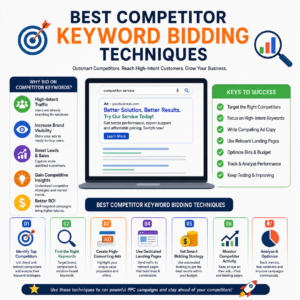
In today’s competitive digital marketing world, businesses are constantly looking for new ways to attract potential customers. One powerful strategy that many advertisers use is competitor keyword bidding. By understanding and implementing the Best competitor keyword bidding techniques, businesses can place their ads in front of users who are already interested in similar products or services.
When done correctly, competitor keyword bidding can help increase website traffic, generate qualified leads, improve brand awareness, and boost sales. However, it requires careful planning, proper keyword selection, compelling ad copy, and continuous optimization.
This comprehensive guide will explain everything you need to know about competitor keyword bidding, including its benefits, challenges, strategies, best practices, and common mistakes to avoid.
Understanding Competitor Keyword Bidding
Competitor keyword bidding is a paid advertising strategy where advertisers bid on keywords related to competing brands, products, or services.
For example, if Company A sells SEO services, it may run Google Ads targeting keywords related to Company B, another SEO agency.
The goal is simple:
- Reach potential customers already interested in similar services
- Increase visibility in competitive markets
- Offer better alternatives
- Capture market share
How It Works
When users search for a competitor’s brand name, your advertisement may appear in the search results if your keyword targeting and bids are effective.
Example:
User searches:
“XYZ Digital Marketing Services”
Your ad appears:
“Looking for Better Marketing Results? Compare Our Affordable SEO Services Today.”
This gives users another option before they make a final purchasing decision.
Why Businesses Use Competitor Keyword Bidding
Many companies use competitor targeting because:
- Customers are already interested in the product category
- Search intent is usually high
- Conversion opportunities increase
- Brand awareness grows quickly
- Market penetration becomes easier
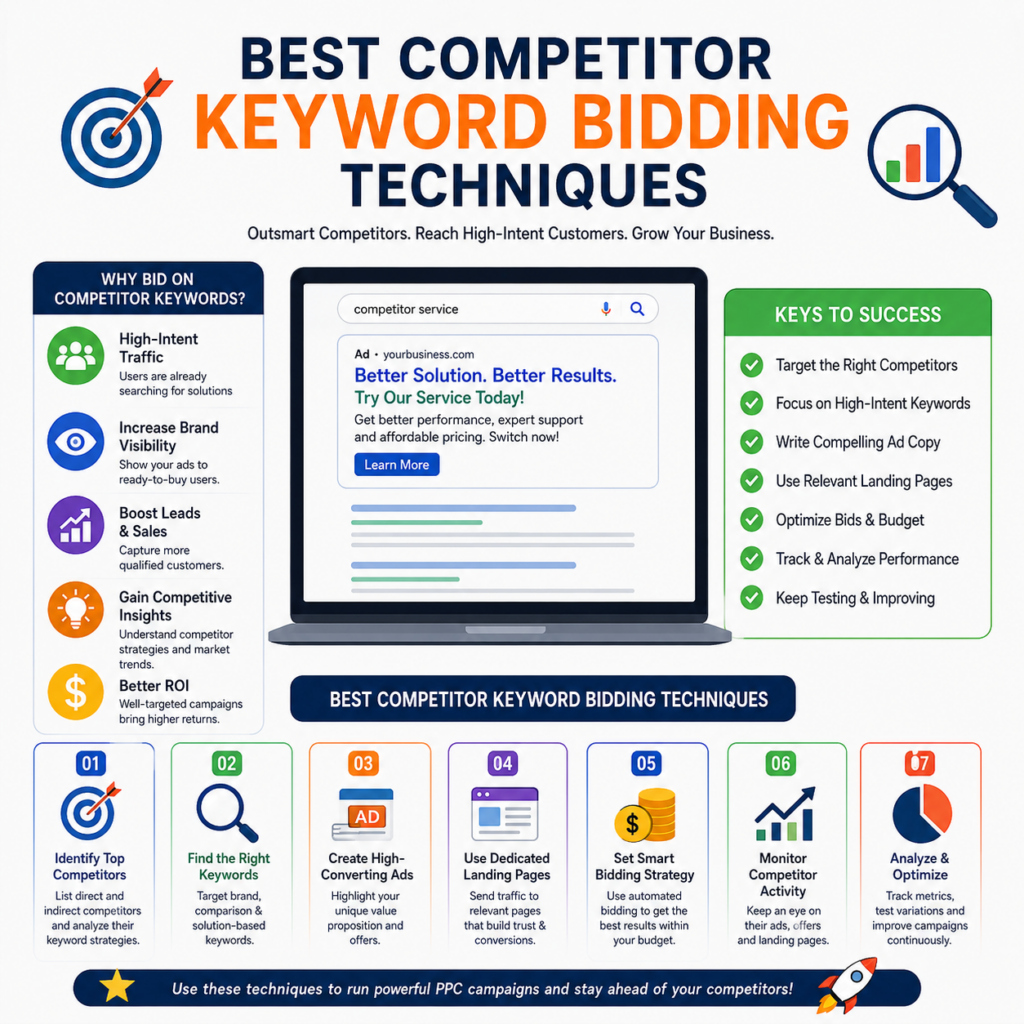
Benefits of Using Best Competitor Keyword Bidding Techniques
Implementing the Best competitor keyword bidding techniques can deliver several advantages for businesses of all sizes.
1. Access to High-Intent Audiences
Users searching for competitors are often close to making a buying decision.
They have:
- Conducted research
- Compared options
- Identified their needs
This makes them highly valuable prospects.
2. Increased Brand Visibility
Appearing alongside competitors helps expose your brand to new audiences.
Benefits include:
- Better market exposure
- Stronger online presence
- More impressions
- Greater brand recall
3. Faster Customer Acquisition
Instead of building awareness from scratch, competitor keyword campaigns target users already interested in similar solutions.
This can shorten the customer journey significantly.
4. Opportunity to Highlight Unique Selling Points
Your ad can emphasize:
- Lower prices
- Better customer support
- Faster delivery
- Additional features
- Free consultations
This helps differentiate your business.
5. Valuable Competitive Insights
Competitor campaigns reveal:
- Market demand
- Customer preferences
- Competitive weaknesses
- Industry trends
These insights can improve overall marketing performance.
Research and Planning for Successful Competitor Keyword Campaigns
Success begins with research. Before launching campaigns, businesses should understand the competitive landscape thoroughly.
Identify Your Main Competitors
Start by listing:
Direct Competitors
Businesses offering similar products or services.
Indirect Competitors
Businesses solving similar customer problems differently.
Market Leaders
Established brands with strong market recognition.
Conduct Competitor Analysis
Analyze:
- Keywords they rank for
- Ad messaging
- Landing pages
- Promotions
- Pricing strategies
Useful tools include:
- Google Keyword Planner
- SEMrush
- Ahrefs
- SpyFu
- Similarweb
Select the Right Competitor Keywords
Not every competitor keyword is worth targeting.
Focus on:
Brand Keywords
Example:
- Competitor company names
- Product names
- Service names
Comparison Keywords
Examples:
- Alternative to XYZ
- Better than XYZ
- XYZ competitor
Solution-Based Keywords
These target customer problems rather than specific brands.
Examples:
- Best CRM software
- Affordable SEO agency
- Email marketing platform
Evaluate Search Volume
Consider:
- Monthly searches
- Competition level
- Estimated CPC
- User intent
Choose keywords that balance traffic potential with profitability.
Best Competitor Keyword Bidding Techniques for Maximum ROI
Now let’s explore the most effective methods marketers use to improve campaign performance.
Technique 1: Focus on Buyer Intent
Prioritize keywords showing strong purchase intent.
Examples:
- Buy CRM software
- Best SEO agency alternative
- Compare project management tools
These users are closer to conversion.
Technique 2: Create Dedicated Ad Groups
Separate competitor campaigns from regular search campaigns.
Benefits:
- Better budget control
- Easier performance tracking
- Improved optimization
Structure campaigns by:
- Individual competitors
- Product categories
- Service types
Technique 3: Write Strong Ad Copy
Your ad should communicate value quickly.
Include:
- Unique benefits
- Competitive advantages
- Special offers
- Clear calls to action
Example:
“Looking for an Alternative? Get Better Results with Our Affordable SEO Solutions.”
Technique 4: Use Comparison Landing Pages
Dedicated landing pages often outperform generic pages.
Include:
- Feature comparisons
- Benefits
- Testimonials
- Case studies
- FAQs
Help visitors make informed decisions.
Technique 5: Leverage Audience Targeting
Combine competitor keywords with:
- Demographics
- Location targeting
- Device targeting
- Remarketing audiences
This improves campaign efficiency.
Technique 6: Monitor Competitor Activity
Competitors constantly update:
- Ads
- Offers
- Pricing
- Messaging
Regular monitoring helps maintain a competitive advantage.
Technique 7: Use Smart Bidding Strategies
Popular options include:
Maximize Conversions
Focuses on generating more conversions.
Target CPA
Controls acquisition costs.
Target ROAS
Optimizes revenue generation.
Enhanced CPC
Adjusts bids based on conversion likelihood.
Common Mistakes to Avoid in Competitor Keyword Bidding
Many advertisers waste money because they overlook important factors.
Targeting Too Many Competitors
Focus on quality rather than quantity.
Start with:
- Top competitors
- High-performing keywords
- Relevant market segments
Ignoring Landing Page Experience
Even great ads fail when landing pages are weak.
Ensure pages provide:
- Fast loading speed
- Clear messaging
- Strong CTAs
- Mobile optimization
Copying Competitor Messaging
Never duplicate competitor ads.
Instead:
- Highlight your strengths
- Create unique offers
- Differentiate your brand
Failing to Track Conversions
Monitor:
- Leads
- Sales
- Form submissions
- Phone calls
Data-driven optimization improves results.
Setting Unrealistic Budgets
Competitor keywords often have higher CPCs.
Allocate budgets strategically and scale gradually.
Not Testing Different Variations
Always test:
- Headlines
- Descriptions
- Landing pages
- CTAs
- Bid strategies
Continuous testing leads to better performance.
Measuring Success and Building Long-Term PPC Growth
Successful competitor campaigns require ongoing monitoring and optimization.
Key Metrics to Track
Click-Through Rate (CTR)
Measures ad engagement.
Conversion Rate
Shows how many visitors complete desired actions.
Cost Per Click (CPC)
Indicates keyword competitiveness.
Cost Per Acquisition (CPA)
Measures customer acquisition costs.
Return on Ad Spend (ROAS)
Evaluates profitability.
Optimization Tips
Review Search Terms Regularly
Add irrelevant searches as negative keywords.
Improve Quality Score
Focus on:
- Relevant keywords
- Better ad copy
- Landing page quality
Test New Competitors
Market conditions change frequently.
Identify emerging competitors and evaluate opportunities.
Refine Audience Segments
Analyze performance by:
- Location
- Device
- Age group
- Customer behavior
Use Remarketing Campaigns
Many users won’t convert immediately.
Remarketing helps bring them back.
Learn Digital Advertising Skills at WebLiquids Institute
If you want to master Google Ads, PPC marketing, competitor analysis, keyword research, and advanced digital marketing strategies, professional training can help accelerate your growth.
Students looking to build practical digital skills can learn at WebLiquids Institute and gain industry-focused training from experienced professionals.
WebLiquids Institute
Institute Name: WebLiquids Institute
Address: SCO 114-115, 2nd Floor, Sector 34-A, Chandigarh, 160022
Phone: 829-829-5419
Website: https://www.webliquids.com
The institute provides practical digital marketing training designed to help students, business owners, freelancers, and professionals build real-world marketing expertise.
Frequently Asked Questions (FAQs)
1. What is competitor keyword bidding?
Competitor keyword bidding is a PPC strategy where advertisers bid on keywords related to competing brands, products, or services.
2. Is competitor keyword bidding legal?
Yes. In most regions, bidding on competitor brand names as keywords is allowed, although trademark rules may restrict certain ad copy usage.
3. Does competitor keyword bidding increase conversions?
It can increase conversions when campaigns target high-intent users and use relevant landing pages.
4. Are competitor keywords expensive?
Often yes. Competitor keywords usually have higher CPCs because multiple advertisers compete for the same audience.
5. Which platform is best for competitor keyword campaigns?
Google Ads is the most popular platform, but Microsoft Advertising can also be effective.
6. Should small businesses use competitor keyword bidding?
Yes. Small businesses can gain visibility and attract customers by targeting carefully selected competitor keywords.
7. What landing page works best for competitor campaigns?
Comparison pages, feature comparison pages, case studies, and alternative solution pages generally perform well.
8. How often should campaigns be optimized?
Weekly reviews are recommended, while major performance evaluations can be conducted monthly.
9. Can competitor keyword bidding improve brand awareness?
Yes. Even when users do not click, repeated exposure increases brand recognition.
10. What is the biggest mistake in competitor keyword advertising?
Failing to differentiate your brand and sending traffic to generic landing pages.
Conclusion
Using the Best competitor keyword bidding techniques can help businesses reach high-intent audiences, improve visibility, generate leads, and compete effectively in crowded markets. Success depends on thorough research, strategic keyword selection, compelling ad copy, optimized landing pages, and continuous performance monitoring.
By applying the Best competitor keyword bidding techniques discussed in this guide, businesses can build stronger PPC campaigns and maximize advertising ROI over time. Whether you are a small business owner, marketer, freelancer, or student, understanding competitor keyword strategies can provide a significant advantage in today’s digital marketplace.
To develop practical expertise in PPC advertising, Google Ads, SEO, and digital marketing, consider learning from experienced professionals at WebLiquids Institute, where industry-focused training helps learners build job-ready skills and real-world marketing confidence.