




How to Optimize Images for SEO: Complete Beginner to Advanced Guide
How to Optimize Images for SEO: Complete Beginner to Advanced Guide Introduction Images play a crucial role in modern websites. Whether you run an e-commerce
Search engine optimization involves many elements that work together to improve a website’s visibility. While most people focus on keywords, backlinks, and content creation, website structure is equally important. One of the most overlooked yet powerful on-page SEO elements is the proper use of heading tags.
Headings help organize content, improve readability, and make it easier for both users and search engines to understand the information on a page. Whether you are creating a blog post, service page, landing page, or product description, a well-structured heading hierarchy contributes significantly to user experience and search performance.
Understanding how to use heading tags in seo is essential for content writers, digital marketers, website owners, and businesses looking to improve online visibility. Proper heading implementation not only helps search engines interpret content but also keeps visitors engaged by presenting information in a clear and organized manner.
In this comprehensive guide, you will learn what heading tags are, why they matter, how they work, common types, best practices, tools, industry applications, career opportunities, and future trends.
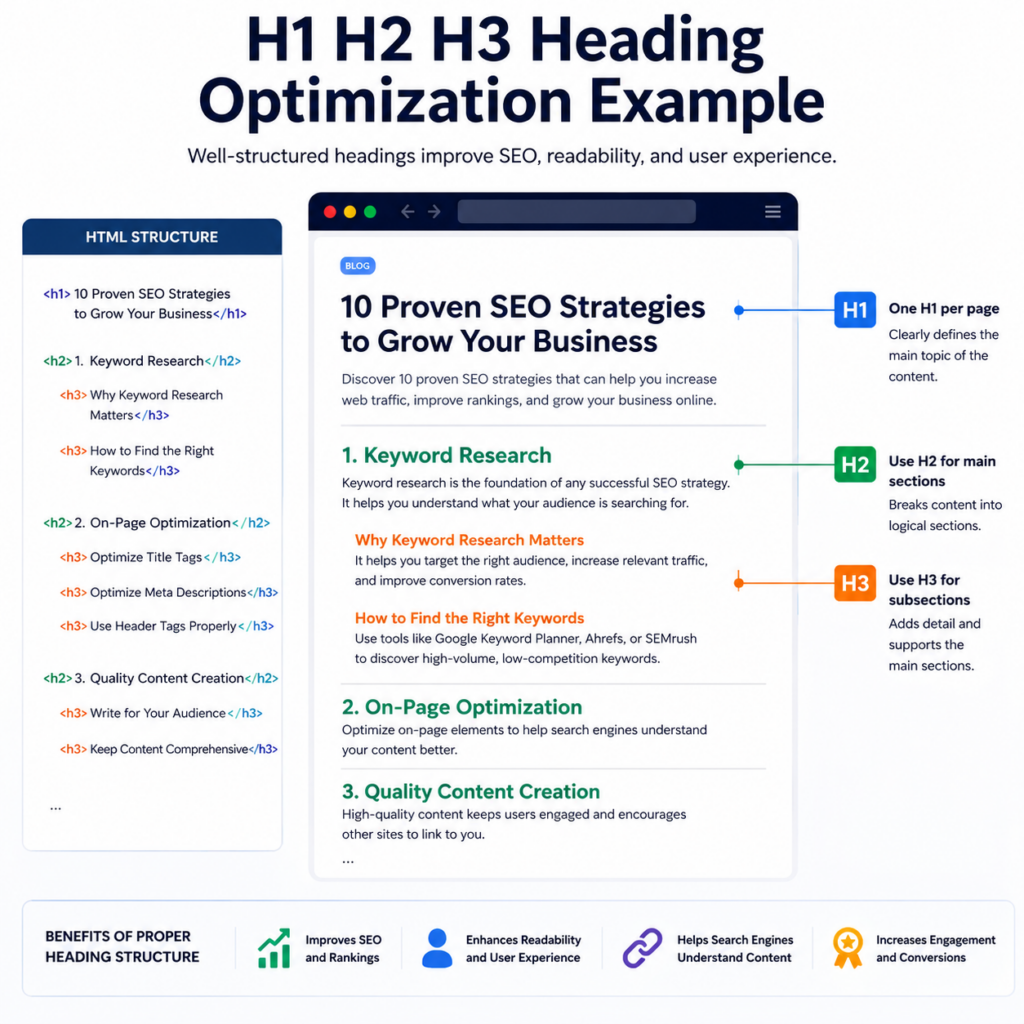
Heading tags are HTML elements used to define headings and subheadings within web content. They range from H1 to H6 and create a structured hierarchy that organizes information logically.
The H1 tag typically represents the main topic of a page, while H2, H3, H4, H5, and H6 tags are used for subtopics and supporting information.
These tags serve two primary purposes:
For example:
H1: Complete Guide to Digital MarketingH2: What is Digital Marketing?
H3: Benefits of Digital Marketing
H2: Digital Marketing Channels
H3: SEO
H3: Social Media Marketing
This hierarchy makes the content easier to scan and understand.
Heading tags offer several important features:
Proper heading structure allows readers to quickly locate information relevant to their needs.
Search engines analyze heading tags to understand the main topics and subtopics on a webpage.
For example, if a page discusses SEO training:
A crawler can quickly determine the overall subject and relationship between different sections.
This structure also helps users navigate content efficiently, especially on mobile devices where readability is crucial.
Heading tags play a major role in modern SEO strategies.
Businesses benefit from properly structured content because:
Digital marketers use heading tags to:
Knowledge of heading optimization is valuable for:
Heading tags are commonly used in:
Understanding how to use heading tags in seo can significantly improve content performance across all these platforms.
The H1 tag is the primary heading of a webpage.
Example:
H1: Beginner's Guide to Search Engine OptimizationBest Practice:
H2 tags divide content into major sections.
Example:
H2: Benefits of SEO
H2: SEO Ranking FactorsThese headings help organize the main discussion points.
H3 tags are used under H2 sections to provide additional details.
Example:
H2: Benefits of SEOH3: Increased Website Traffic
H3: Better User Experience
These tags are used when deeper content hierarchy is needed.
Example:
H4: Technical SEO Audits
H5: Crawlability Analysis
H6: XML Sitemap ReviewAlthough less common, they are useful for large knowledge-base articles and technical documentation.
Identify the primary subject of your page.
Example:
SEO Training CourseThis becomes your H1.
Break the content into logical topics.
Examples:
These become H2 headings.
Use H3 tags to explain important details.
Example:
H2: CurriculumH3: SEO Fundamentals
H3: Keyword Research
H3: Link Building
Never jump from H1 directly to H4.
Correct hierarchy:
H1
→ H2
→ H3
→ H4Use important search terms where appropriate without forcing them.
Keep headings:
Ask yourself:
Proper implementation of how to use heading tags in seo improves both search visibility and user experience.
Helps monitor search performance and page visibility.
Allows users to inspect heading structures quickly.
Identifies heading issues across websites.
Shows heading hierarchy directly within the browser.
Provides content analysis and SEO recommendations.
Offers site audits and on-page optimization reports.
Identifies heading structure improvements and SEO opportunities.
Ideal for WordPress users.
Provides heading and content optimization suggestions.
Helps create well-structured SEO content.
These tools simplify the process of analyzing and improving heading structures.
Online stores use headings to organize:
Example: An electronics store structures smartphone reviews with H2 and H3 sections.
Hospitals and healthcare websites organize information about:
This improves accessibility and readability.
Educational websites structure:
Students can easily navigate content.
Property portals use headings to organize:
Travel websites use heading tags for:
Technology companies structure documentation using detailed heading hierarchies.
Financial institutions organize content related to:
Startups use headings to improve landing page conversions and website clarity.
Local businesses structure service pages for better search visibility.
Agencies rely heavily on optimized headings to improve content rankings and user engagement.
Heading optimization is a valuable skill within digital marketing and content development.
Common positions include:
Professionals should understand:
As businesses increase digital investments, demand for SEO professionals continues to rise.
Professionals can advance into:
Freelancers can offer services such as:
Businesses frequently seek experts who understand how to use heading tags in seo as part of broader content optimization strategies.
The future of heading optimization remains strong despite advances in artificial intelligence and automation.
Search engines continue to prioritize user experience and content structure.
As websites expand, organized content becomes increasingly important.
AI-generated content still requires proper organization and hierarchy.
Heading tags help search engines understand machine-generated and human-written content alike.
Emerging trends include:
SEO tools increasingly automate content analysis.
However, strategic heading structure decisions still require human expertise.
Organizations need professionals who can create content that is both user-friendly and search-engine-friendly.
SEO and content optimization skills are expected to remain highly relevant for years to come.
For individuals interested in developing professional SEO and digital marketing skills, WebLiquids Institute offers practical learning opportunities designed around current industry requirements.
Located at:
WebLiquids Institute
SCO 114-115, 2nd Floor, Sector 34-A, Chandigarh, 160022
Phone: 829-829-5419
Website: https://www.webliquids.com
Students learn through a combination of:
The training approach focuses on real-world implementation rather than theory alone. Learners gain experience working with SEO tools, website optimization techniques, content strategies, keyword research methods, and on-page SEO practices, including heading tag optimization.
This practical exposure helps students build confidence while preparing for careers in digital marketing, SEO, content writing, and online business growth.
Heading tags are among the most important yet frequently underestimated elements of on-page SEO. They create a clear structure for both users and search engines, improving readability, accessibility, and content organization.
When implemented correctly, heading tags help search engines understand page topics, support keyword relevance, and enhance the overall user experience. From blogs and e-commerce websites to educational portals and business websites, proper heading hierarchy contributes to better content performance.
As digital competition continues to grow, professionals who understand content structure and SEO fundamentals will remain in demand. Whether you are a student, business owner, marketer, or aspiring SEO specialist, mastering heading optimization is a valuable skill that can support long-term success in the digital landscape.
Answer: Heading tags are HTML elements ranging from H1 to H6 that organize content into a structured hierarchy. They help search engines understand page topics and improve readability for users navigating web pages.
Answer: Generally, one H1 tag is recommended per page. It represents the main topic and helps establish a clear content hierarchy for search engines and visitors.
Answer: Heading tags are not direct ranking factors alone, but they help search engines understand content structure, improve user experience, and support overall on-page SEO performance.
Answer: Relevant keywords can be included naturally in headings when appropriate. However, headings should remain clear, descriptive, and useful rather than being written solely for search engines.
Answer: It is generally recommended to maintain a logical hierarchy. Skipping levels can create confusion for users and search engines trying to understand the content structure.
Answer: Content writers, bloggers, SEO professionals, digital marketers, website owners, and business professionals can benefit from learning heading tag optimization techniques.
Answer: Basic concepts can be learned within a few days. Mastering advanced content structuring and SEO implementation may take several weeks of practice and real-world application.
Answer: Career opportunities include SEO Executive, SEO Analyst, Content Strategist, Digital Marketing Specialist, SEO Consultant, and freelance SEO professional roles across multiple industries.
Answer: Certifications can strengthen your resume and demonstrate knowledge, but practical experience, project work, and measurable SEO results are often more valuable to employers.
Answer: Yes. As search engines continue prioritizing user experience and content quality, properly structured heading hierarchies will remain a fundamental part of effective SEO and content optimization.

How to Optimize Images for SEO: Complete Beginner to Advanced Guide Introduction Images play a crucial role in modern websites. Whether you run an e-commerce

How to Optimize Content for SEO: A Complete Guide for Better Rankings Introduction Content plays a central role in digital marketing. Whether you run a

Facebook Page Optimization: Complete Guide for Better Reach and Engagement Introduction Facebook remains one of the most powerful social media platforms for businesses, entrepreneurs, educators,

What is Social Media Optimization? Complete Guide for Beginners Introduction Social media has transformed the way businesses communicate with customers. Millions of people spend hours

How to Find Low Competition Keywords: Complete SEO Guide Introduction Keyword research is the foundation of every successful SEO campaign. No matter how valuable your
Lorem ipsum dolor sit amet consectetur adipiscing elit. Quisque faucibus ex sapien vitae pellentesque sem placerat. In id cursus mi pretium tellus duis convallis. Tempus

How to Find Low Competition Keywords: Complete SEO Guide Introduction Keyword research is the foundation of every successful SEO campaign. No matter how valuable your

How to Use Heading Tags in SEO: Complete Guide for Better Rankings Introduction Search engine optimization involves many elements that work together to improve a

How to Create SEO-Friendly URLs: Complete Guide for Better Rankings Introduction Search engine optimization involves many factors, including content quality, website speed, backlinks, and technical

What Is Meta Description in SEO? Complete Guide for Beginners Introduction When people search for information online, search engines display a list of results that

Understanding Meta Titles and Meta Descriptions: A Complete SEO Guide Introduction When users search for information on search engines, the first thing they usually notice